The Beartooth Plateau
The Beartooth Plateau contains some of the oldest exposed rocks on Earth and provides a unique window into the history of our planet. About 55 million years ago, this massive block of metamorphic basement rock pushed its way upward nearly two miles along steep faults that extend deep into the Earth. The exposed rock consists of coarse-grained gray and pink granites, gneisses, and schists that formed about 3.3 billion years ago when older sedimentary and volcanic rocks were heated and recrystallized deep in the Earth at extremely high temperatures. The plateau contains the oldest exposed rocks in Montana and they are among the oldest on Earth. The Stillwater Complex on the plateau’s northern flank is one of the world’s major sources of chromite, platinum, and palladium.
During the ice ages, about 100,000 years ago, the Beartooth Plateau collected enough snow for glaciers to form and cover most of the plateau to a depth of several thousand feet. The spreading glaciers wore down the plateau’s upper surface to leave the distinctively rounded rock outcrops, along with hundreds of lakes, ponds, and depressions. They flowed down old stream valleys, leaving them deepened and straightened, with vertical canyon walls and jagged peaks. The summit of the plateau is alpine tundra.
Chrome Mines
The Beartooth Plateau contains one of the only known sources of chromite ore in North America. The mineral is used to manufacture chromium steel alloys, such as stainless steel. Although first discovered in the Beartooths in the late nineteenth century, it wasn’t until World War II that the ore was mined. At the beginning of the United States’ involvement in the war in 1941, the country was entirely dependent on foreign sources of chromite. When German U-boats disrupted the shipping lanes, the federal government acquired and developed the mining properties in the Beartooth Range. It spent over $12 million developing the Benbow, Mouat, and Gish mines, including the construction of mills and mining camps for the miners and their families. The Montana Highway Department rebuilt the roads between Columbus and the mills so that the strategic mineral could be shipped out on the Northern Pacific Railway. Almost as soon as the mines began production, the tide of war turned, reopening the sea lanes from South Africa. All three Montana mines shut down in 1943. The Korean Conflict compelled the federal government to reopen the Mouat Mine in 1953. It operated until 1961 when the government permanently closed down the mine.
Slide toward Today to fade the historical sheet and see the modern map underneath.
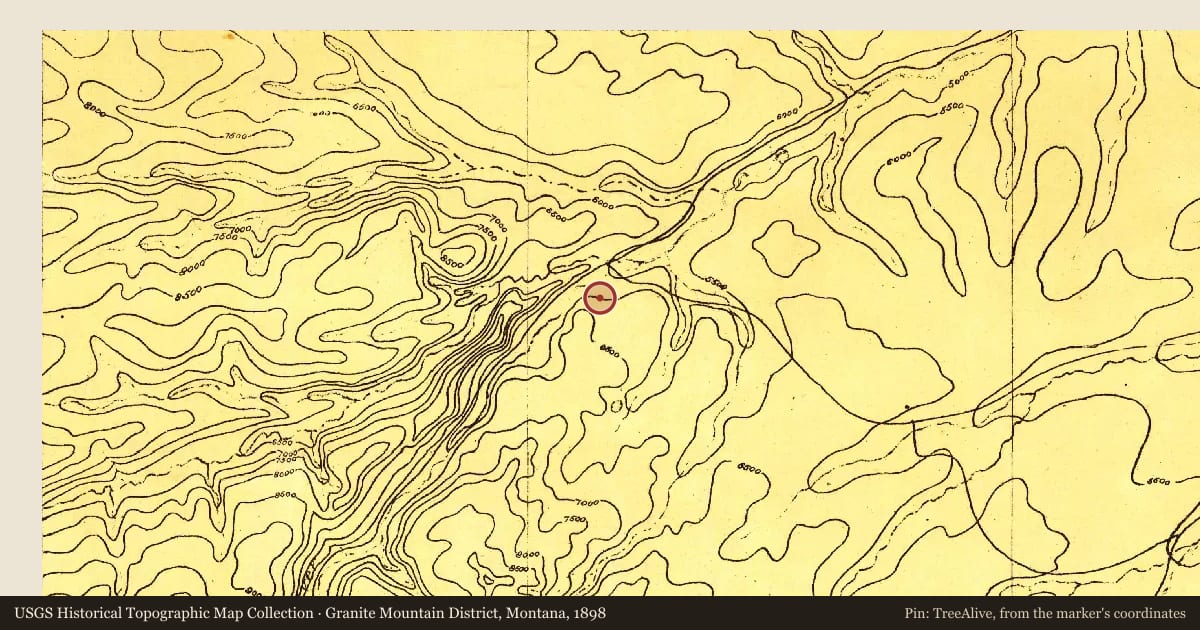
Granite Mountain District, Montana, 1898, covering this location. USGS Historical Topographic Map Collection. The pin is ours, placed from the marker's coordinates.
Example
For example, one family's tree showed the Articles of Confederation marker in Pennsylvania standing under a mile from where William Gabby lived in the 1760s.
What that marker records spans 1777 to 1789, overlapping William Gabby's years there.