National Register of Historic Places
Oconee Hill Cemetery
Athens, Clarke County, Georgia
The record
- Listed
- May 22, 2013
- Type
- Historic district
- Address
- 297 Cemetery St., Athens
- County
- Clarke
- State
- Georgia
- Contributing resources
- 4 buildings, 3 structures, 1 sitebuildings, sites and structures that add to its history
- Coordinates
- 33.94724, -83.36722
- Reference number
- 13000291
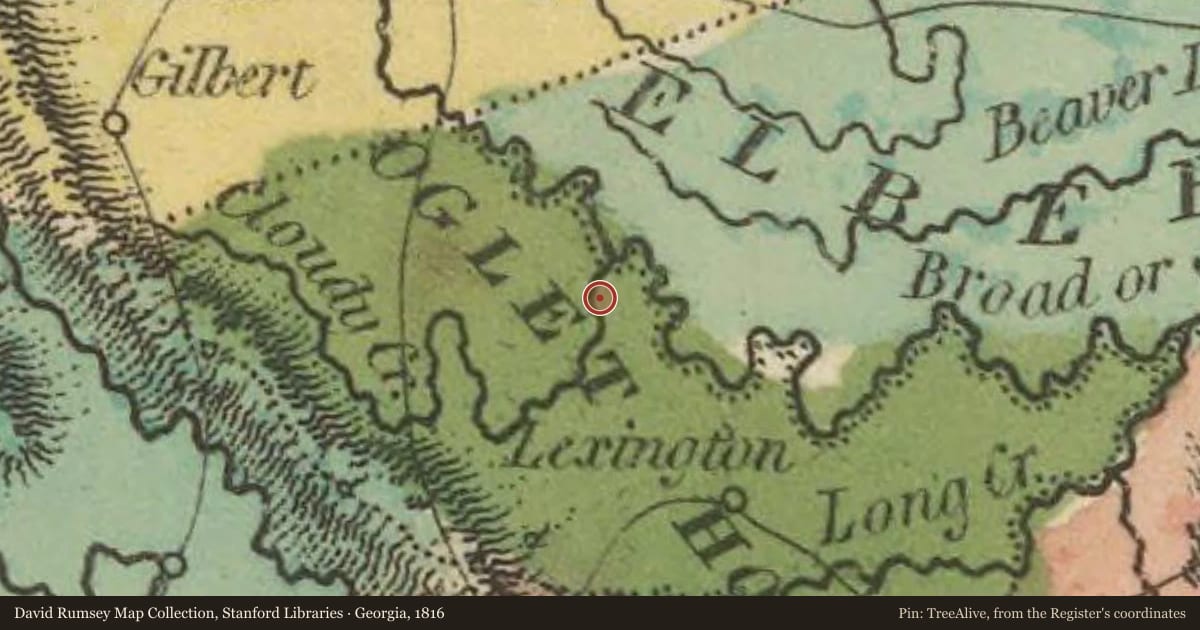
Slide toward Today to fade the historical sheet and see the modern map underneath.
The outline is the area recorded for this listing in National Park Service map data, drawn approximately.
David Rumsey Map Collection, Stanford LibrariesDavid Rumsey Map Collection, Stanford LibrariesDavid Rumsey Map Collection, Stanford LibrariesDavid Rumsey Map Collection, Stanford LibrariesDavid Rumsey Map Collection, Stanford LibrariesUSGS Historical Topographic Map Collection
Historical maps covering this location
- 1816 · Georgia. (David Rumsey Map Collection, Stanford Libraries)
- 1831 · Georgia. (David Rumsey Map Collection, Stanford Libraries)
- 1845 · Georgia (David Rumsey Map Collection, Stanford Libraries)
- 1869 · Georgia. (David Rumsey Map Collection, Stanford Libraries)
- 1895 · Military map, W.T. Sherman. (David Rumsey Map Collection, Stanford Libraries)
- 1964 · Athens East, Georgia (USGS Historical Topographic Map Collection)
Who held this land, and when? See it on the Atlas.
The story
Written by AI from this property's National Register nomination and the record above; every sentence is checked against its sources before it appears here. Corrections: privacy@treealive.com
Oconee Hill Cemetery is a historic cemetery district on 99 acres at 297 Cemetery St. in Athens, Clarke County, established in 1856.
What the Register recognized
It was listed in the National Register in 2013 under criteria A, B, C and D, with state-level significance in architecture, art, landscape architecture, community planning and development, engineering, and Black and other ethnic heritage. Its significance runs from 1856, when the cemetery was established, to 1963.
Physical character
An iron-and-steel Pratt through-truss bridge, built in 1899 by the George E. King Company, spans the river 90 feet long and 40 feet above the water, with vertical lattice supports in compression and diagonal rods in tension. The sexton's house, built in 1907, was rebuilt that year from a small gable-and-wing house into a Georgian-plan house with a central hall and a full-width front porch with sawn balusters and brackets.
Historical context
White and African-American pauper sections were established in 1857, and the city of Athens took land from the Black pauper ground during 1899 sewer line construction. In 1873 the Congregation Children of Israel bought land from the Athens Manufacturing Company and established a Jewish burial section there. James H. Bisson served as sexton from 1897 to 1927, followed by Bert Guernsey Bisson from 1927 to 1960 and Bert Jr. from 1960 to 1983.
Criterion A means tied to important events; B, to an important person; C, to its design or construction; D, to what it can still teach us.
Nearby on the Register
- Oconee Street SchoolBuildingunder 1 mi
- Gov. Wilson Lumpkin HouseBuildingunder 1 mi
- Athens FactoryHistoric districtunder 1 mi
- Jackson Street CemeterySiteunder 1 mi
Other National Register listings within about three miles of this one, by straight line.
Historical markers nearby
- United States Navy Pre-Flight Schoolunder 1 mi
- Old Collegeunder 1 mi
- Cook & Brother Confederate Armoryunder 1 mi
- Herty Fieldunder 1 mi
Historical markers within about three miles of this listing, by straight line.