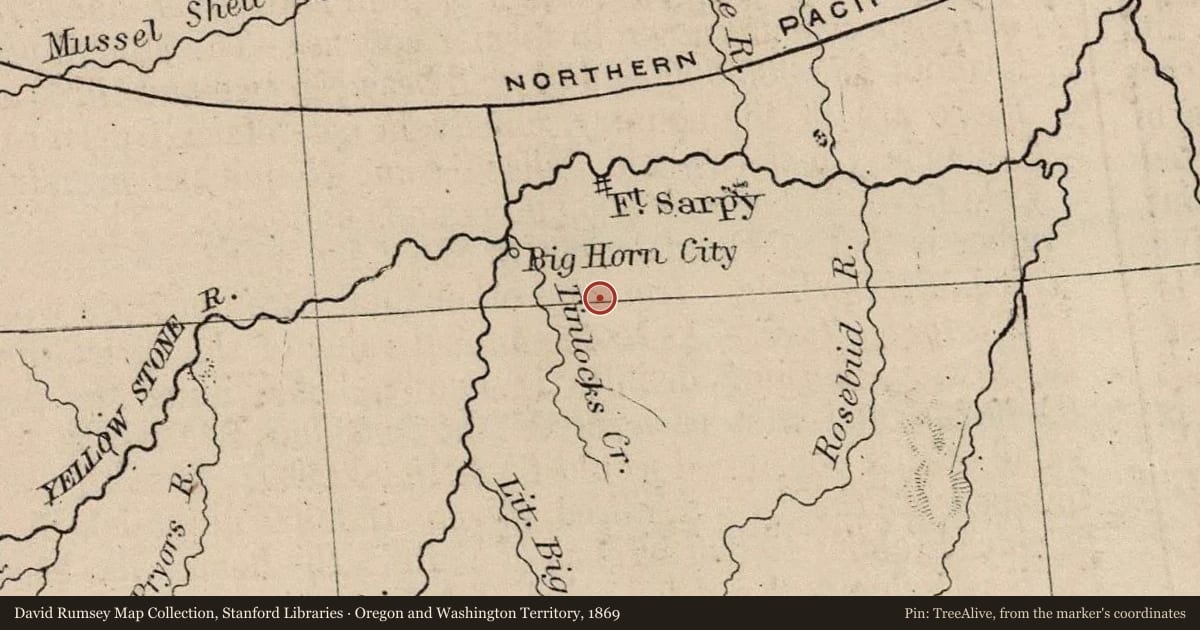
The mouth of the Big Horn River as it enters the Yellowstone, 13 miles east of here, is one of the most significant areas in Montana history. The Crow Indians knew the Yellowstone as the Elk River. French explorers called it the la Roche Jaune. French trader François Larocque named it the Great Horn River, while the Crow called it Lisaxpúatahcheeaashisee, the Large Bighorn Sheep River. Captain William Clark of the Lewis and Clark Expedition, on his return trip from their journey to the Pacific Ocean, camped on the east bank of the Big Horn River on July 26, 1806. The following year, in November 1807, an expedition led by Manuel Lisa, a St. Louis fur trader, arrived at the mouth of the Big Horn River. He built a fur trading post which he named Fort Remon in honor of his two-year-old son. This was the first building erected in what is now the State of Montana. From here Lisa sent John Colter to make contact with the Indians to induce them to come to his post and trade their furs for goods. On this journey Colter experienced the wonders of present-day Yellowstone National Park. In 1876 during the Sioux and Cheyenne Indian campaign of that year, General Terry and Colonel Gibbon marched up the Big Horn River to the site of Custer’s defeat at the Battle of the Little Big Horn. They arrived two days after the battle. The steamer Far West, carrying supplies, plied the waters of both rivers and brought the wounded from that encounter back to Fort Abraham Lincoln, Dakota Territory.
Slide toward Today to fade the historical sheet and see the modern map underneath.
For example, one family's tree showed the Articles of Confederation marker in Pennsylvania standing under a mile from where William Gabby lived in the 1760s.
What that marker records spans 1777 to 1789, overlapping William Gabby's years there.