Dearborn Crossing
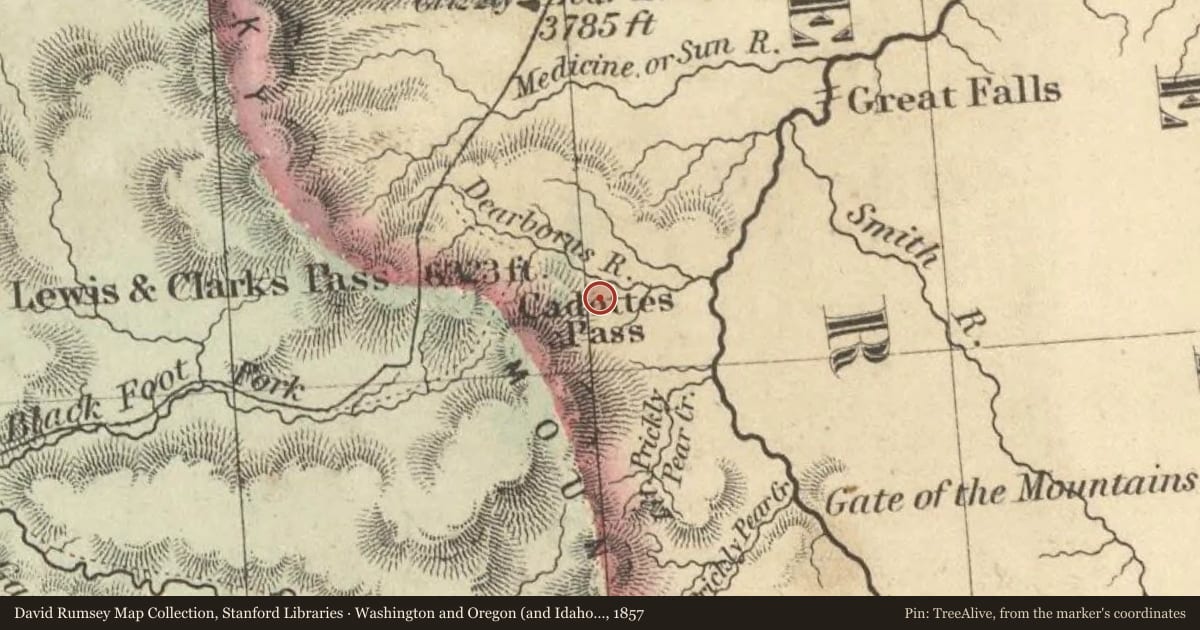
Dearborn Crossing is a Montana historical marker in Lewis and Clark County.
Get directions ↗Start a road tripHistorical trails
Slide toward Today to fade the historical sheet and see the modern map underneath.
USGS Historical Topographic Map CollectionUSGS Historical Topographic Map CollectionDavid Rumsey Map Collection, Stanford LibrariesDavid Rumsey Map Collection, Stanford LibrariesDavid Rumsey Map Collection, Stanford Libraries
Historical maps covering this location
- 1857 · Washington and Oregon (and Idaho and Montana) (David Rumsey Map Collection, Stanford Libraries)
- 1859 · Department of Oregon. Map of the state of Oregon and Washington Territory (David Rumsey Map Collection, Stanford Libraries)
- 1869 · Oregon and Washington Territory. (David Rumsey Map Collection, Stanford Libraries)
- 1955 · Choteau, Montana (USGS Historical Topographic Map Collection)
- 1957 · Choteau, Montana (USGS Historical Topographic Map Collection)
For example, one family's tree showed the Articles of Confederation marker in Pennsylvania standing under a mile from where William Gabby lived in the 1760s.
What that marker records spans 1777 to 1789, overlapping William Gabby's years there.
Upload your family tree and TreeAlive finds the markers near where your own ancestors lived.
See your family's markersStart with a tree file, a FamilySearch sign in, or a WikiTree ID.
Report a problem with this page
At the marker right now? You can send us the spot you're standing on.
We may pass what you report to the state's marker program. Please don't include personal details.
Marker data: Montana Department of Transportation, Montana's Historical Highway Markers, marker texts reproduced with the Department's written permission.