National Register of Historic Places
Pope Villa
Lexington, Fayette County, Kentucky
The record
- Listed
- August 30, 2018
- Type
- Building
- Address
- 326 Grosvenor Ave., Lexington
- County
- Fayette
- State
- Kentucky
- Period of significance
- 1900 to 1924the years that made it historic
- Coordinates
- 38.03953, -84.49578
- Reference number
- 05000785
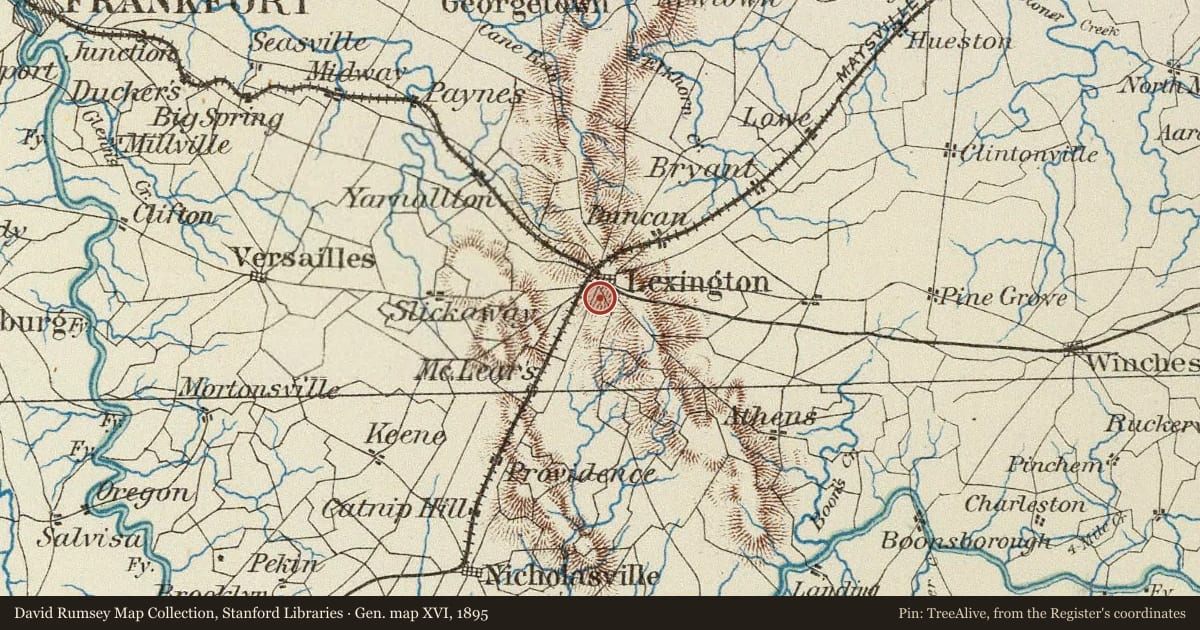
Slide toward Today to fade the historical sheet and see the modern map underneath.
David Rumsey Map Collection, Stanford LibrariesDavid Rumsey Map Collection, Stanford LibrariesDavid Rumsey Map Collection, Stanford LibrariesDavid Rumsey Map Collection, Stanford Libraries
Historical maps covering this location
- 1876 · County and Road Map of Kentucky. (David Rumsey Map Collection, Stanford Libraries)
- 1886 · J.T. Barker's Railroad and Township Map of Indiana. (David Rumsey Map Collection, Stanford Libraries)
- 1895 · Gen. map XVI. (David Rumsey Map Collection, Stanford Libraries)
- 1924 · Kentucky. (David Rumsey Map Collection, Stanford Libraries)
The story
Written by AI from this property's National Register nomination and the record above; every sentence is checked against its sources before it appears here. Corrections: privacy@treealive.com
Pope Villa is a brick house at 326 Grosvenor Ave. in Lexington, Fayette County, designed by Benjamin Henry Latrobe, completed in 1812 in the Federal style.
What the Register recognized
It was listed under criterion C, with national significance in architecture.
Physical character
The house is built of brick on a stone foundation, with a rotunda about 19 feet across and 22 feet high, ringed by columns and pilasters, and finished inside with marble mantelpieces and a punch-work chair rail. Thomas Lewinski remodeled it in the Italianate style in 1865, and a 1987 fire later damaged the rotunda dome.
Historical context
Senator John Pope and his wife Eliza lived in the house from 1812 until her death in 1818; Pope leased it out until selling it to Catherine Barry in 1836. Henry Johnson bought the property in 1843, and Joseph and Lucy Woolfolk purchased it in 1865, using it as a summer residence until 1900. The Woolfolks divided the land into 40 lots in 1900 and sold the house in 1914, after which it was cut into apartments, ten of them by the 1960s, until a 1987 fire led the Blue Grass Trust for Historic Preservation to buy the property and restore it by 1990.
Criterion A means tied to important events; B, to an important person; C, to its design or construction; D, to what it can still teach us.
Nearby on the Register
- Southeast Lexington Residential and Commercial DistrictHistoric districtunder 1 mi
- Elley VillaBuildingunder 1 mi
- Featherston, Edmonson and Clark HousesBuildingunder 1 mi
- James Burnie Beck HouseBuildingunder 1 mi
Other National Register listings within about three miles of this one, by straight line.