National Register of Historic Places
Baltimore Light Station
Gibson Island vicinity, Anne Arundel County, Maryland
The record
- Listed
- December 2, 2002
- Type
- Structure
- Address
- Gibson Island, Gibson Island vicinity
- County
- Anne Arundel
- State
- Maryland
- Period of significance
- 1900 to 1974the years that made it historic
- Contributing resources
- 1 structurebuildings, sites and structures that add to its history
- Coordinates
- 39.05930, -76.39872
- Reference number
- 02001417
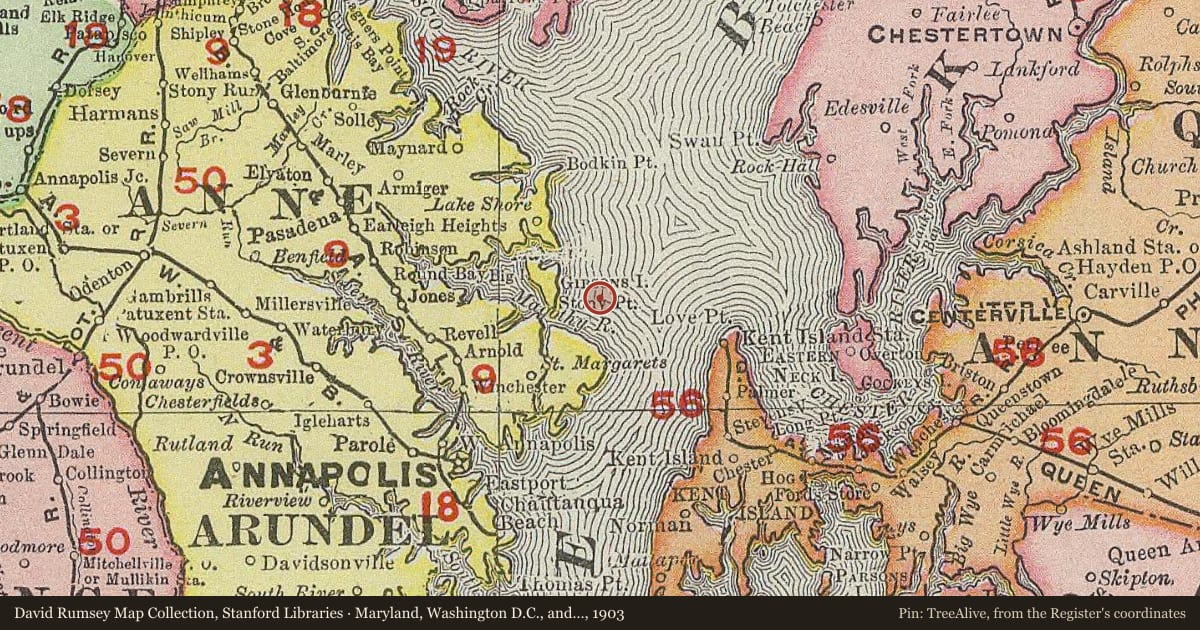
Slide toward Today to fade the historical sheet and see the modern map underneath.
David Rumsey Map Collection, Stanford LibrariesUSGS Historical Topographic Map CollectionDavid Rumsey Map Collection, Stanford LibrariesUSGS Historical Topographic Map CollectionDavid Rumsey Map Collection, Stanford Libraries
Historical maps covering this location
- 1889 · Virginia and West Virginia (eastern portion). (David Rumsey Map Collection, Stanford Libraries)
- 1889 · Maryland and Delaware. (David Rumsey Map Collection, Stanford Libraries)
- 1893 · North Point, Maryland (USGS Historical Topographic Map Collection)
- 1903 · Maryland, Washington D.C., and Delaware. (David Rumsey Map Collection, Stanford Libraries)
- 1904 · North Point, Maryland (USGS Historical Topographic Map Collection)
Who held this land, and when? See it on the Atlas.
The story
Written by AI from this property's National Register nomination and the record above; every sentence is checked against its sources before it appears here. Corrections: privacy@treealive.com
The Baltimore Light Station is a lighthouse near Gibson Island in Anne Arundel County, built in 1908, reportedly in the Second Empire style.
What the Register recognized
It was listed under criteria A and C, with local significance in maritime history, transportation and architecture, and under Criteria Consideration G. Its period of significance runs from 1908, when it was built, to 1964, when it became the first and only nuclear-powered lighthouse in the United States.
Physical character
The brick tower stands on a caisson foundation and rises to an octagonal lantern under a metal mansard roof; its cast-iron window frames and lightning spindle remain, and the dormer windows, removed in 1988, were rebuilt to the original plans in 1992. A solar panel now powers the light, after the 1964 nuclear generator was removed.
Historical context
William H. Flaherty and Frederick Martin Lande of Brooklyn, New York built the lighthouse, commissioned October 1, 1908, with a fourth-order lens, after Congress appropriated funds in 1894 and 1904. It operated with keepers from 1908 to 1964 under the U.S. Lighthouse Board and later the U.S. Coast Guard, and its fog signal was discontinued in 1923 when the illuminant changed from oil to acetylene.
Criterion A means tied to important events; B, to an important person; C, to its design or construction; D, to what it can still teach us.