Montana is not only famous for its Big Sky, but it's also famous for its geological treasures, like gold, silver, copper, platinum, coal, oil, and fossils. The most famous of its fossils are its dinosaurs, and Montana boasts more species of dinosaurs than any other state (more than 75). The oldest dinosaurs, found in rocks of the Jurassic Period (155 million years old), include animals like Diplodocus, Stegosaurus, and Allosaurus. Most Montana dinosaurs come from Cretaceous Period rocks. Early Cretaceous rocks (120 million years ago) yield species such as the infamous "raptor" Deinonychus, and from Middle Cretaceous rocks (90 million years old) comes the burrowing dinosaur Oryctodromeus. From the early part of the Late Cretaceous (80-75 million years ago) comes the nesting dinosaurs Maiasaura and Troodon, the herding, horned dinosaur Einiosaurus, and the large carnivorous dinosaur Daspletosaurus. From the latest Cretaceous rocks (65 million) comes Tyrannosaurus, Triceratops, and Ankylosaurus. Throughout the Mesozoic Era, when dinosaurs ruled this region the climate and geography were very different from today. Inland embayments of the Pacific Ocean (during Jurassic times), and the Atlantic Ocean (Cretaceous period) provided the area with a subtropical climate. Many of these dinosaur specimens can be seen in museums on Montana's Dinosaur Trail. In the modern era, the Big Sky drew tourists to Montana even during the darkest days of the Great Depression in the 1930s. The lure of wide open spaces, recreational opportunities, and Montana’s Old West heritage drew thousands of the people to the state. A good road system and cheap gasoline made it easy for thousands of people to enjoy their visit here. The Montana Highway Department (now MDT) developed programs that catered to visitors to the state. They included colorful highway maps, informative brochures, ports-of-entry stations, roadside picnic areas, museums, and information centers. In 1935, the department began installing roadside interpretive markers to tell readers about Montana’s colorful history. Written by Robert H. “Bob” Fletcher, the signs were intended to tell a good story in a style reminiscent of a cowboy leaning against a car spinning a yarn to a greenhorn. The markers were tremendously popular and continue, after seventy years, to induce people to pull over and read them.
Slide toward Today to fade the historical sheet and see the modern map underneath.
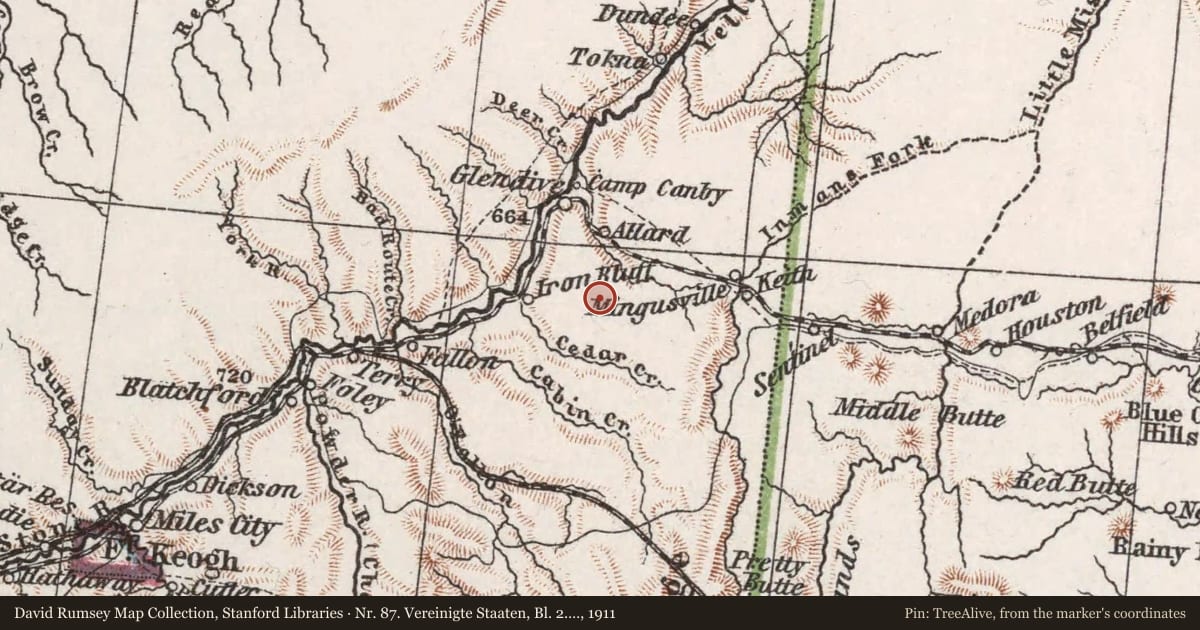
1911 · Nr. 87. Vereinigte Staaten, Bl. 2. ... von H. Habenicht. (David Rumsey Map Collection, Stanford Libraries)
1927 · North Dakota. (David Rumsey Map Collection, Stanford Libraries)
1953 · Miles City, Montana (USGS Historical Topographic Map Collection)
1957 · Miles City, Montana (USGS Historical Topographic Map Collection)
1958 · Miles City, Montana (USGS Historical Topographic Map Collection)
Nr. 87. Vereinigte Staaten, Bl. 2. ... von H. Habenicht, 1911, covering this location. David Rumsey Map Collection, Stanford Libraries. The pin is ours, placed from the marker's coordinates.
Example
For example, one family's tree showed the Articles of Confederation marker in Pennsylvania standing under a mile from where William Gabby lived in the 1760s.
What that marker records spans 1777 to 1789, overlapping William Gabby's years there.