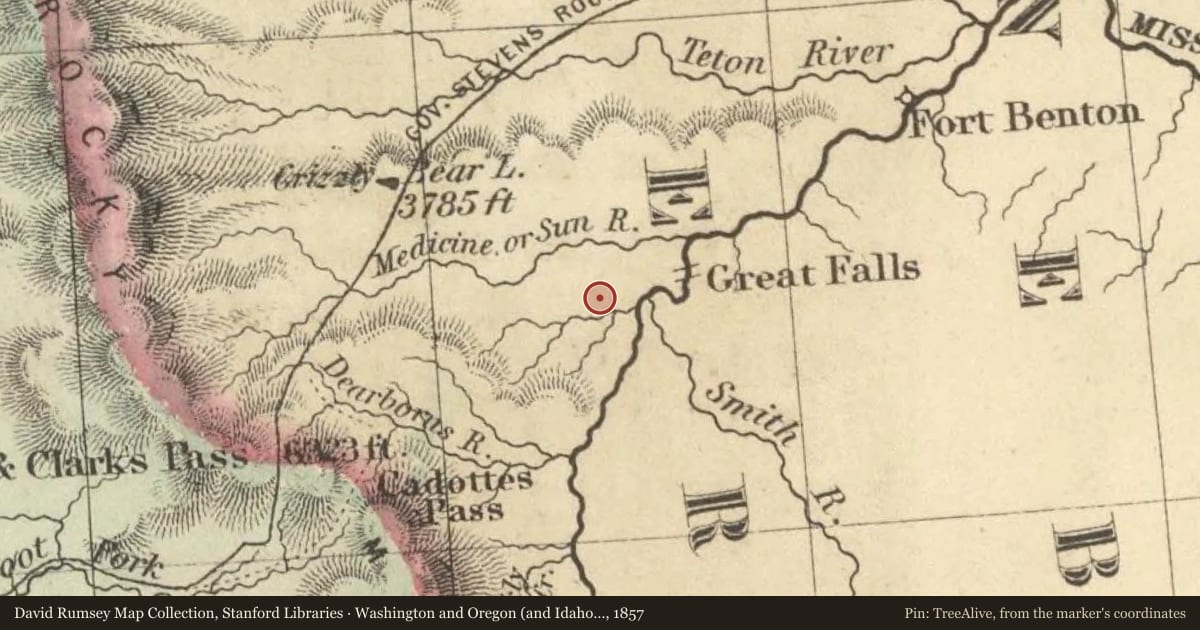
When John Mullan built a wagon road from western Montana in 1860, he utilized a ford across the Sun River just a few yards west of here that had been used by the Indians for generations. Johnny Healy established a trading post on the north side of the ford in 1867 to trade with his Blackfeet neighbors and travelers on the Benton Road. He also operated a ferry for those who didn’t want to cross the river during high water. After the gold strikes in southwestern Montana, traffic between the mining camps and Fort Benton made the Sun River Crossing an important place. Healy and John Largent built a toll bridge at the crossing in 1867. Largent ran a hotel, store, and blacksmith shop on the south side of the river. A settlement quickly grew up near the bridge and prospered because of the road. During the 1870s, Sun River Crossing boasted hotels, general merchandise stores, saloons, and a brewery operated by Bill Weigand. Several livery stables were also located in the settlement. Sun River Crossing was an important rendezvous place for cowboys, bullwhackers, muleskinners, trappers, and Indians as well as an important stopping place for thousands of others who traveled on the Benton Road. Although the completion of the Montana Central Railroad in 1887 made travel easier between Fort Benton and Helena, it did not, at first, diminish the importance of Sun River Crossing and it continued to thrive until after 1900. Today, the community and the bridge (in its fourth incarnation) attest to the strategic importance of this place and its significance to Montana history.
The Sun River Farm
In 1858, the first Blackfeet Indian agent, Alfred Vaughan, established a 180-acre farm on the Sun River near here. Established under the terms of the Lame Bull Treaty of 1855, the farm was intended to instruct the Blackfeet “in agricultural and mechanical pursuits.” The farm got off to a slow start when drought destroyed the first crops. Then for several years, ideal growing conditions produced bountiful harvests of wheat, oats, and vegetables. The farm complex included a residence for the superintendent, living quarters for the hired hands, as well as barns, chicken coops, and other outbuildings. Vaughan’s optimism in the farm remained high during his tenure in Montana. By the mid-1860s, however, things had taken a turn for the worse as relations between whites in the area and the Blackfeet deteriorated. It culminated in 1866 when Blackfeet raiders burned down the farm buildings and killed two of the operation’s employees. Later that year, new Indian agent George Wright reported that the “general appearance [of the farm] is that of desolation” with all the buildings, farm implements stolen, and the fields overgrown with weeds.
One of Montana’s most notorious criminals, Henry Plummer, visited the Sun River Farm in 1862. He and partner Jack Cleveland enjoyed the hospitality of the superintendent, James Vail, and his wife, Martha. While there, Plummer met and fell in love with Martha’s sister, Electa Bryan. They married the following year and moved to Bannack, where he was the sheriff and head of the road agent gang, “the Innocents.” Electa may not have known about her husband’s secret life until vigilantes hanged him in January 1864.
Slide toward Today to fade the historical sheet and see the modern map underneath.
For example, one family's tree showed the Articles of Confederation marker in Pennsylvania standing under a mile from where William Gabby lived in the 1760s.
What that marker records spans 1777 to 1789, overlapping William Gabby's years there.