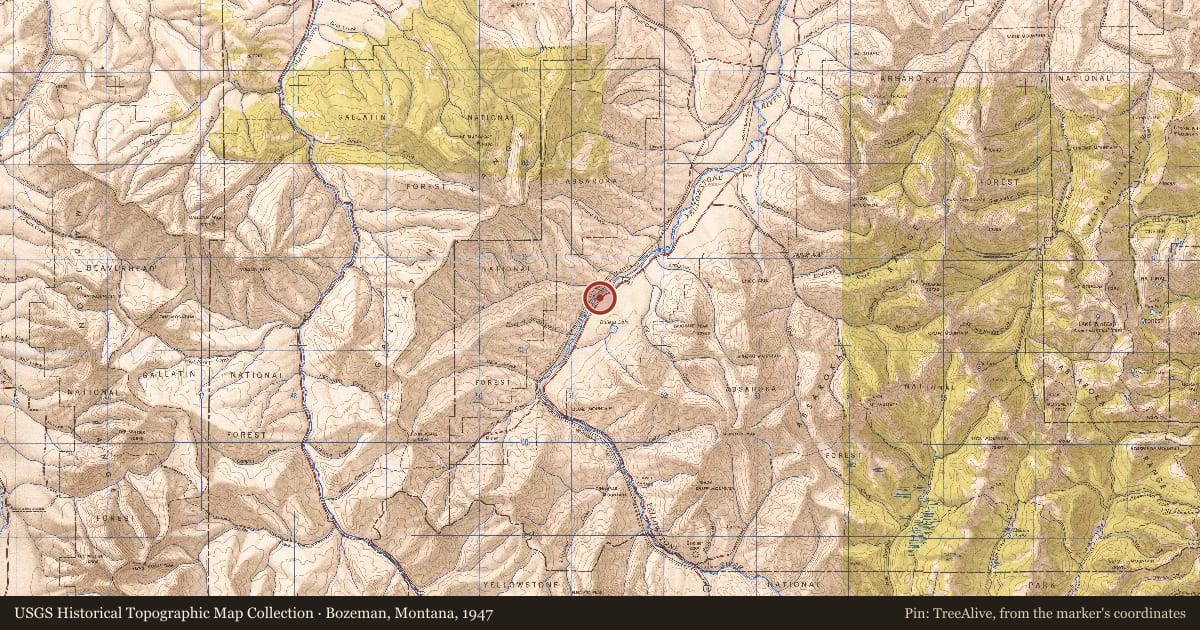
The black-capped bluffs located on the east side of the Yellowstone River are called Hepburns Mesa. The mesa is capped by a basalt lava flow that probably erupted from a small local volcanic vent that has long since eroded away. Geologically, the lava flow is very young, perhaps having erupted as recently as 2.2 million years ago. Large amounts of iron in the basalt make it dark colored. Some of the iron crystallized as the mineral magnetite, which as the name implies is magnetic, and in large concentrations can cause compasses to behave erratically. The basalt flow overlies unconsolidated gravels, which in turn overlie older light-colored fine-grained sedimentary rocks that were deposited in an ancient lake that occupied this site. The sedimentary beds of Hepburn’s Mesa contain abundant Miocene fossils, including ancient rodents, moles, and proto-horse called Merychippus, the first equine to exhibit the distinctive head of today’s horses. On top of Hepburn’s Mesa, overlying the basalt is glacial till of Pleistocene age. The surface of these deposits is hummocky and is littered with abundant glacial erratic boulders. For generations, Native Americans drove bison off the mesa’s cliffs to obtain food, hides, and other materials important to their way of life.
Hepburn’s Mesa is named for John Hepburn, a local rancher, rockhound and amateur paleontologist. He arrived in the Emigrant area in 1909 and after working in Yellowstone National Park for many years. In 1935, Hepburn built and opened a museum next to Secondary Highway 540 that displayed many of the geologic specimens and fossils he had found in the mesa area. Many specimens have been pressed into the concrete foundation of the building. The museum was a local landmark for many years, closing in 1959 when Hepburn died. The museum still stands next to the old highway and is listed on the National Register of Historic Places.
Slide toward Today to fade the historical sheet and see the modern map underneath.
Yellowstone National Park, Northern Pacific Railroad (Historical map archives, georeferenced via Allmaps)
Bozeman, Montana, 1947, covering this location. USGS Historical Topographic Map Collection. The pin is ours, placed from the marker's coordinates.
Example
For example, one family's tree showed the Articles of Confederation marker in Pennsylvania standing under a mile from where William Gabby lived in the 1760s.
What that marker records spans 1777 to 1789, overlapping William Gabby's years there.