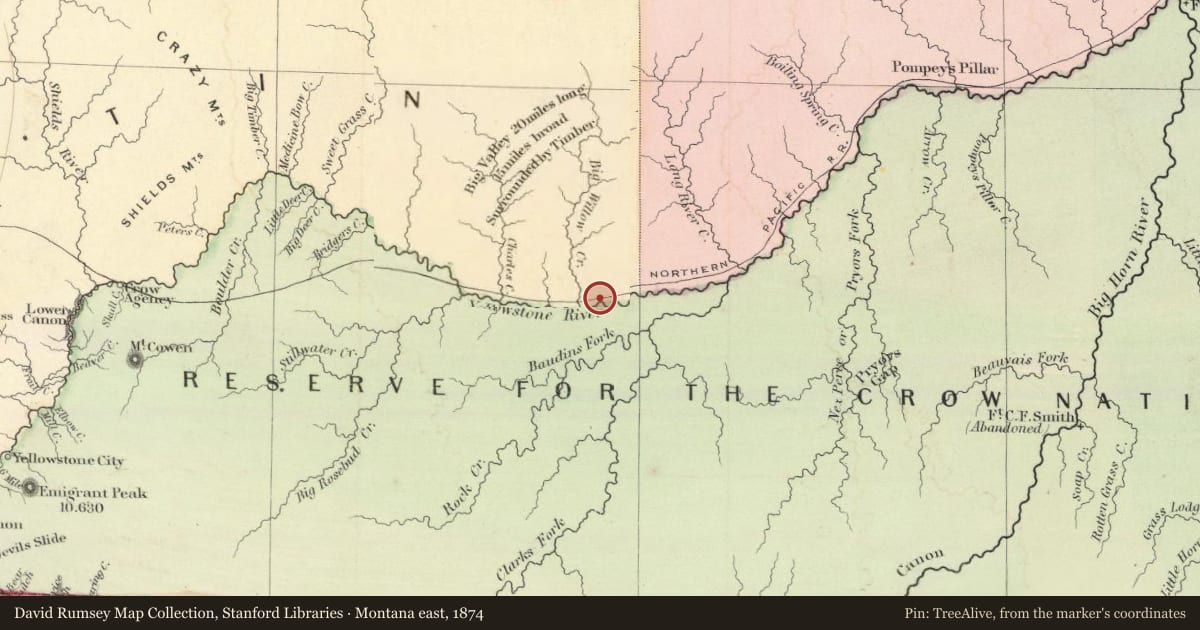
Columbus, located ten miles west of here, has a rich and colorful history. In 1874, whiskey trader Horace Countryman built a trading post a few miles west of the future site of Columbus. The Crow Reservation was then on the south side of the Yellowstone River and, at first, his main customers were Crow Indians. Two years later, Countryman’s trading post became a stage station called Stillwater. He opened a post office at the station in 1877. Other men saw potential in the trade with the Crows. In 1879, business partners Mithoff and Kaufman opened a trading post opposite the mouth of the Stillwater River. Called Eagle’s Nest, the post proved more popular than Countryman’s venture, boasting a hotel, blacksmith, harness shop, and a telegraph station along with a few dwellings. The traders distilled a particularly vile whiskey that tasted like insecticide, earning the trading post the nickname of “Sheep Dip.”
By 1881, Countryman had relocated his stage station and post office, still called Stillwater to the present site of Columbus. Eagle’s Nest and its infamous whiskey, soon disappeared. After the arrival of the Northern Pacific Railway in 1882, Stillwater prospered as an important shipping and trade center in the area. Countryman became a respectable businessman in the community and a hero to some for his 200-mile ride to Helena with news of the Battle of the Little Bighorn in 1876. In 1894, the railroad and postal authorities changed the name of the settlement from Stillwater to Columbus to avoid confusion with a similarly name community in Minnesota.
In 1899, a group of Montana businessmen created the Montana Sandstone Company to quarry building stone north of Columbus. The stone was used to construct buildings all over Montana, including the State Capitol building in Helena. In 1913, Columbus became the seat of newly created Stillwater County.
“Our course led us past Countryman’s ranch, a couple of miles below the camp, the last occupied house on the Yellowstone. It is a trading establishment, whisky being the principal commodity and the customers being Crow Indians.”
-Lieutenant James H. Bradley.
Slide toward Today to fade the historical sheet and see the modern map underneath.
For example, one family's tree showed the Articles of Confederation marker in Pennsylvania standing under a mile from where William Gabby lived in the 1760s.
What that marker records spans 1777 to 1789, overlapping William Gabby's years there.