Major Seth Mabry, a former Confederate Army officer, came to the Redwater Valley about 1883, driving a herd of longhorns from Texas. President of the Mabry Cattle Co., he branded with a plain circle iron. From the brand, the operation became known as the Circle Ranch. They sold three to four thousand beeves each fall for about 13 years. Other cattlemen ran the ranch until about 1900 when Peter Dreyer and Hans Grue bought it and used it as a summer camp for sheep and as a stop-over for themselves and other ranchers going to and from Glendive. Two bachelors supposedly cared for the ranch, but also ran a saloon there. Since strong drink spoiled the sheepherders’ work habits, Dreyer and Grue offered the place to Dreyer’s brother-in-law, Peter Rorvik, in 1903. During an absence of the saloonkeepers, the Rorviks and their six children moved in. The next summer saw 100,000 sheep on the Redwater River. The herders and ranchers needed a supply source, so Rorvik opened a store on the ranch. So began the town of Circle about one-half mile southeast of here. In 1907, the surrounding lands were opened to homesteading and the area has been producing grain as well as livestock ever since.
253. Old Fort Gilbert Montana 200, MP 58, north of Sidney
Old Fort Gilbert was situated directly east of this point on the west bank of the Yellowstone River. The Fort was named after Colonel Charles C. Gilbert, a career army officer who served in the Civil War. The fort originated as a trading post and was taken over by the US Army in 1864. This point also marks the south boundary of what would become the Fort Buford Military Reservation in 1866. Fort Buford was located just across the North Dakota border on the north bank of the Missouri River at the mouth of the Yellowstone. It was named after Major General John Buford, a Union Army officer who had served with distinction during the Battle of Gettysburg. The Army abandoned Fort Gilbert in 1867, shortly after the establishment of Fort Buford.
Fort Buford was an important military post during the Indian Wars. The Army expanded the post in 1868 and again in 1872 as tensions with the Lakota and Northern Cheyenne tribes mounted. In July 1881, the great Lakota leader Sitting Bull and his Hunkpapa band surrendered to the military there after many years of exile in Canada after the Battle of the Little Bighorn. The US Army abandoned Fort Buford in 1895. By taking the side road just north of here and going west a short distance to Fort Gilbert Lookout Point, on the bluffs, you have an excellent view of the Yellowstone Valley. It’s well worth the drive.
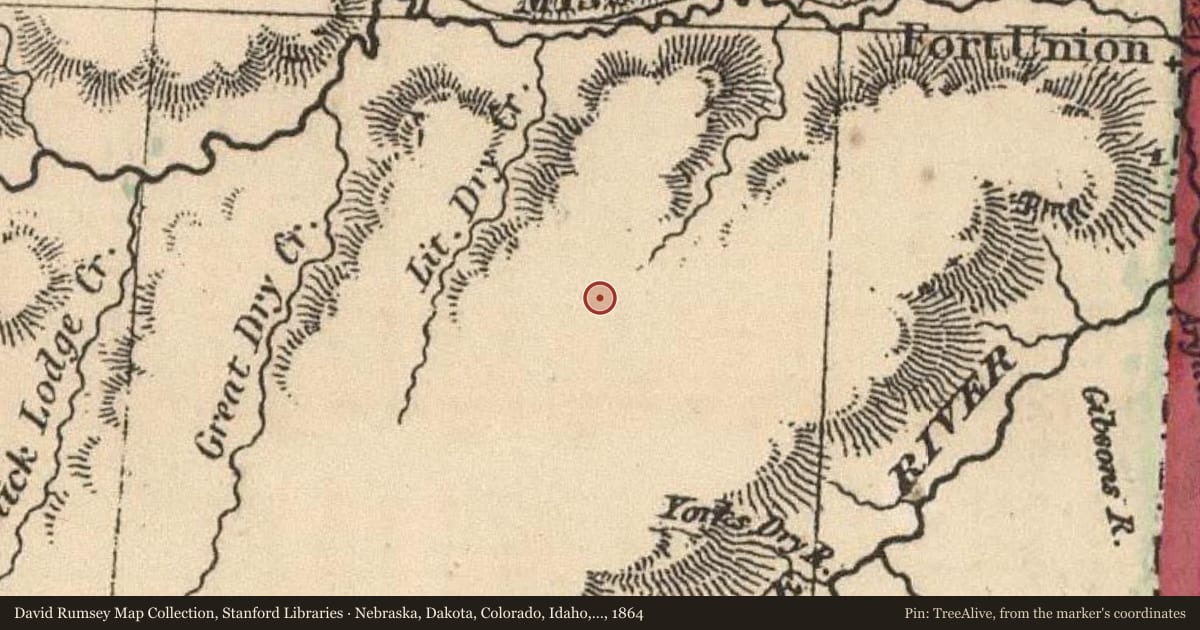
Slide toward Today to fade the historical sheet and see the modern map underneath.
For example, one family's tree showed the Articles of Confederation marker in Pennsylvania standing under a mile from where William Gabby lived in the 1760s.
What that marker records spans 1777 to 1789, overlapping William Gabby's years there.