About sixty million years ago, this area was part of a vast subtropical coastal plain with major rivers flowing eastward into an inland seaway located in present day North and South Dakota. Between these major river systems great thicknesses of plant material accumulated that was converted to peat and eventually buried under sand, mud, and other sediments. Over millions of years, the increased pressure and temperature from burial compressed and baked the peat into medium grade sub-bituminous coal. Between about 70 to 55 million years ago, tectonic forces caused dramatic deformation of the region and culminated in the formation of mountain ranges like the Beartooth, Pryor, and Big Horn Mountains. This regional deformation tilted the sedimentary layers and associated coal seams in this area downward to the east. The coal in the Bear Creek field is part of the immense Fort Union Formation, which is estimated to contain over 200 billion tons of coal in eastern and central Montana. Discovered by “Yankee Jim” George in 1866, the Bear Creek coal field could not be profitably mined until the arrival of the Yellowstone Park Railroad in 1906. Five companies operated coal mines in this narrow valley by 1910. Two nearby towns, Bearcreek and Washoe, provided living quarters and services to the multi-ethnic miners and their families. The field contains about a dozen workable coal beds, with some seams as thick as 11 feet. These beds were easily accessible to miners from outcrops along Bear Creek and Scotch Coulee, but underground mining was necessary as the miners followed the dipping seams into the hillsides. Coal production peaked in the early 1920s, when Bear Creek coal powered Northern Pacific Railway locomotives, fueled the Anaconda Copper Mining Company smelter in Anaconda, and heated homes throughout Montana. Production gradually diminished as the railroads converted to diesel-powered locomotives and the Anaconda smelter and private homes began using natural gas. A brief revival in mining activity in the Bear Creek field during World War II ended in 1953 when the Smith Mine closed. Small privately operated companies provided coal to area residents for years afterwards. Large deposits of coal remain underground, but underground water and thick overburden make the coal difficult to reach. Today, Bear Creek’s coal mining heritage still marks the landscape.
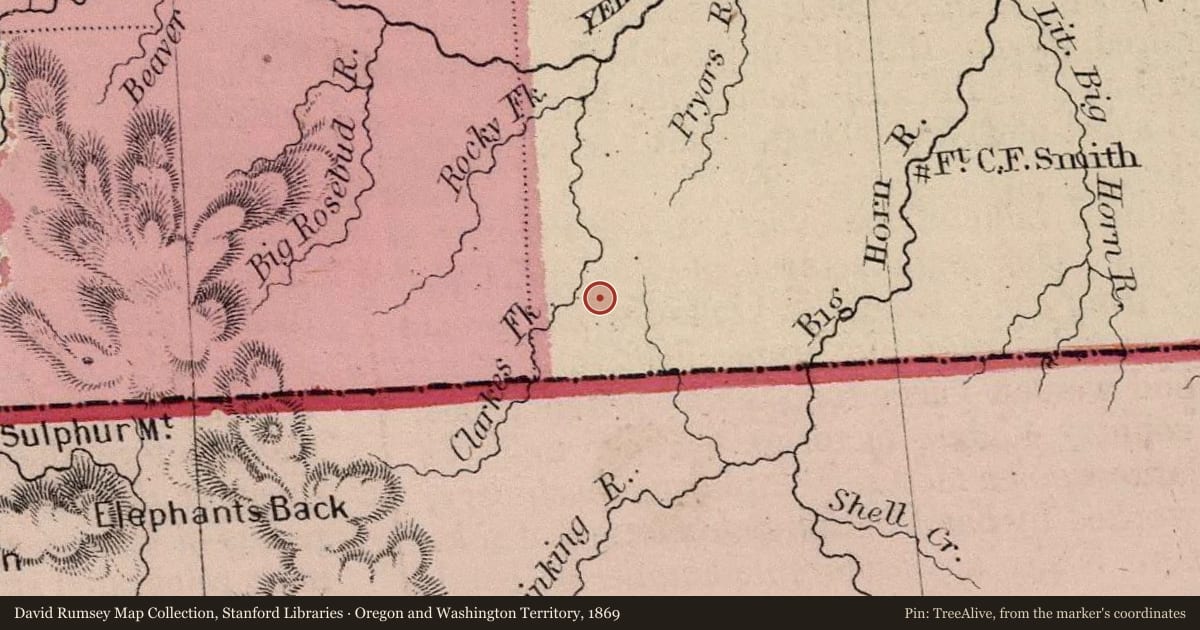
Slide toward Today to fade the historical sheet and see the modern map underneath.
For example, one family's tree showed the Articles of Confederation marker in Pennsylvania standing under a mile from where William Gabby lived in the 1760s.
What that marker records spans 1777 to 1789, overlapping William Gabby's years there.