St. George Episcopal Church
St. George Episcopal Church is a Florida historical marker in Fort George Island, Duval County, dedicated 2005.
Get directions ↗Start a road tripHistorical trails
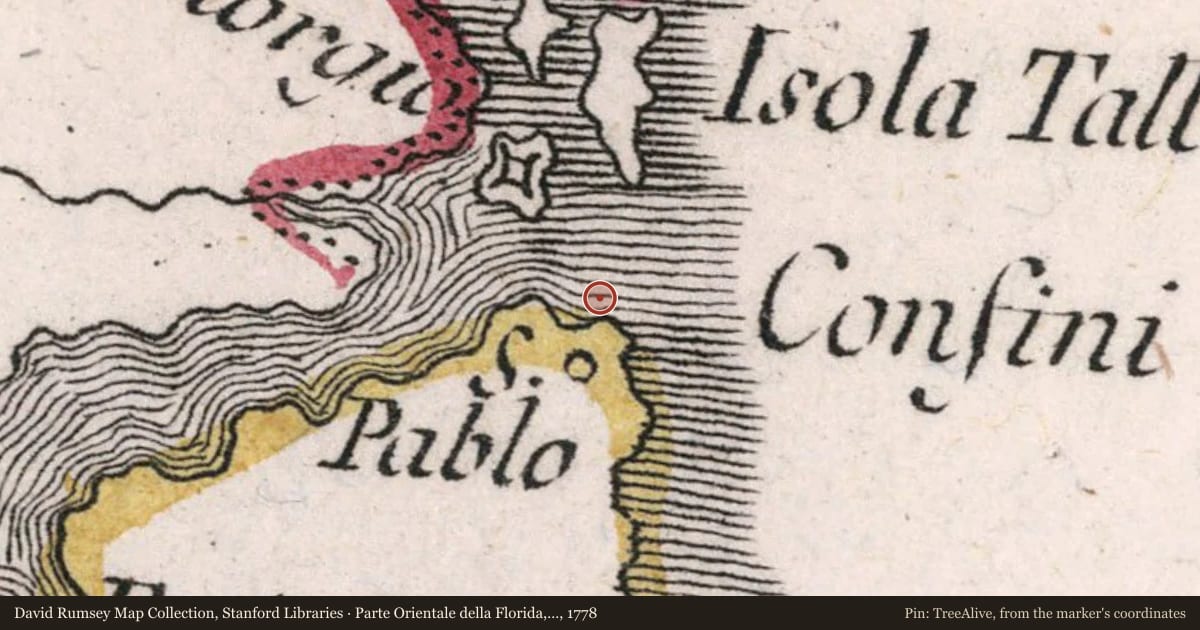
Maps this old were drawn largely by eye, so places on them can sit miles from where they really are. The pin is ours and marks the marker's location today.Maps this old were drawn largely by eye, so places on them can sit miles from where they really are. The pin is ours and marks the marker's location today.
Slide toward Today to fade the historical sheet and see the modern map underneath.
David Rumsey Map Collection, Stanford LibrariesDavid Rumsey Map Collection, Stanford LibrariesBarry Lawrence Ruderman Map Collection, Stanford LibrariesBarry Lawrence Ruderman Map Collection, Stanford LibrariesDavid Rumsey Map Collection, Stanford Libraries
Historical maps covering this location
- 1764 · Carte de la Nouvelle Georgie (David Rumsey Map Collection, Stanford Libraries)
- 1778 · Parte Orientale della Florida, della Giorgia, e Carolina Meridionale. Fogl. XI (David Rumsey Map Collection, Stanford Libraries)
- 1806 · Carolinas, Georgia, Floridas, Bahamas. (David Rumsey Map Collection, Stanford Libraries)
- 1826 · Georgia (A. Finley, 1826) (Barry Lawrence Ruderman Map Collection, Stanford Libraries)
- 1836 · Georgia Pocket Map (Mitchell, 1836) (Barry Lawrence Ruderman Map Collection, Stanford Libraries)
For example, one family's tree showed the Articles of Confederation marker in Pennsylvania standing under a mile from where William Gabby lived in the 1760s.
What that marker records spans 1777 to 1789, overlapping William Gabby's years there.
Upload your family tree and TreeAlive finds the markers near where your own ancestors lived.
See your family's markersStart with a tree file, a FamilySearch sign in, or a WikiTree ID.
Report a problem with this page
At the marker right now? You can send us the spot you're standing on.
We may pass what you report to the state's marker program. Please don't include personal details.
Marker data: Florida Historical Marker Program, Division of Historical Resources, Florida Department of State
More markers nearby
- The Huguenot Memorial Siteunder 1 mi
- Pilot Town/ Napoleon Bonaparte Browardunder 1 mi
- Site of the Mission of San Juan Del Puertounder 1 mi
- Fort George Islandunder 1 mi
On the National Register nearby
Places within about 300 feet of this marker that are listed on the National Register of Historic Places. A nearby listing is not always the marker's own subject.