Side One: On July 17, 1821, celebrations in Pensacola marked the United States’ official acquisition of Spanish Florida. The people in attendance represented Pensacola’s diverse multicultural and multiethnic population. Many of them now rest in nearby St. Michael’s Cemetery. This marker is near the historic bay-side entrance that led to the military and administrative heart of Pensacola during the First Spanish, British, and Second Spanish periods (1756 – 1821). It is also near the historic location of the fort’s flagpole where the official exchange of flags took place in 1821. Archaeological research by the University of West Florida identified features and materials reflecting the continuous use of the Commanding Officer’s Compound site from the colonial era up to the modern day. The archaeological evidence revealed details about how Pensacola’s past communities changed and coalesced throughout history. This marker celebrates Florida’s 200th anniversary as part of the United States, and recognizes Pensacola’s historic role as the county seat of Escambia County and as the colonial capital of West Florida. It commemorates the city’s diverse past and our continued effort toward a more perfect union. Side Two: El 17 de julio de 1821, las celebraciones en Pensacola marcaron la adquisición de la Florida española por los Estados Unidos. Los asistentes representaban la población multicultural y multiétnica. Muchos de ellos descansan ahora en el Cementerio St. Michael’s. Esta placa está cerca de la entrada del corazón militar y administrativo de Pensacola durante el primer periodo español, el periodo británico y el segundo periodo español (1756 – 1821). Esta placa está también está cerca de la ubicación histórica del asta del fuerte, donde se llevó a cabo el intercambio oficial de banderas en 1821. La investigación arqueológica de la Universidad de West Florida identificó materiales que reflejaban el uso del sitio del Commanding Officer’s Compound desde la era colonial hasta la actualidad. La arqueología ha revelado detalles sobre los cambios de las comunidades de Pensacola y su integración a lo largo de la historia. Este placa celebra el 200 aniversario de Florida como parte de los Estados Unidos y reconoce el papel histórico de Pensacola como sede del condado de Escambia County y como la capital colonial de West Florida. Conmemora el pasado tan variado de la ciudad y el continuo esfuerzo hacia una unión más perfecta.
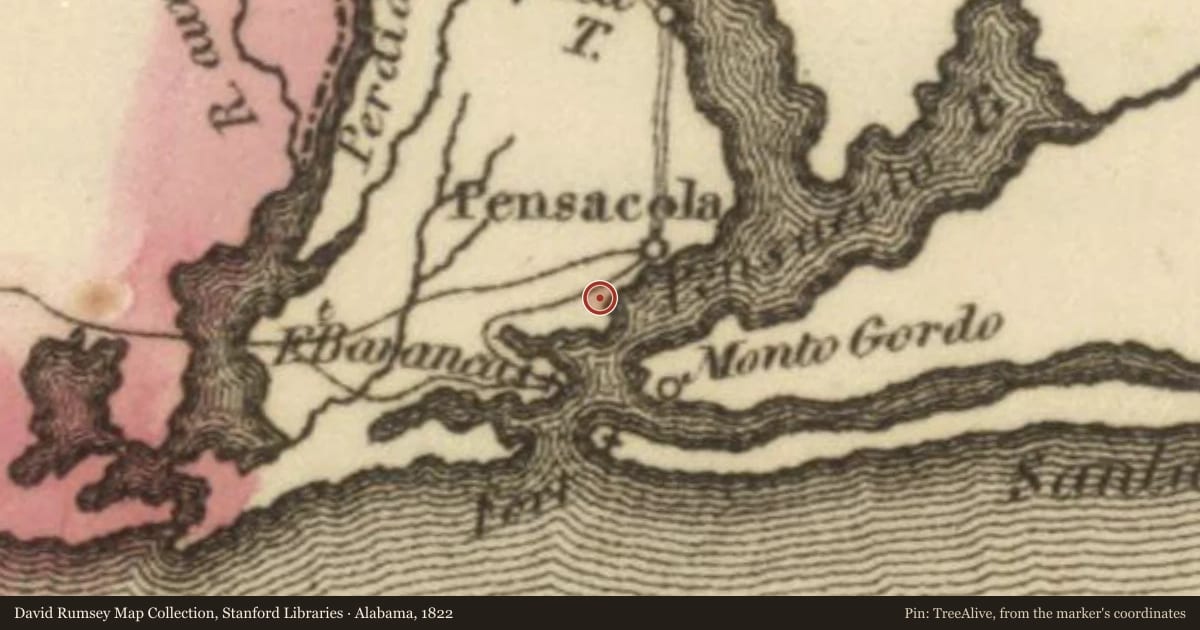
Maps this old were drawn largely by eye, so places on them can sit miles from where they really are. The pin is ours and marks the marker's location today.
Slide toward Today to fade the historical sheet and see the modern map underneath.
For example, one family's tree showed the Articles of Confederation marker in Pennsylvania standing under a mile from where William Gabby lived in the 1760s.
What that marker records spans 1777 to 1789, overlapping William Gabby's years there.
Places within about 300 feet of this marker that are listed on the National Register of Historic Places. A nearby listing is not always the marker's own subject.