Cof Cymru: National Historic Assets of Wales · Wales
Fron Goch Lead Mine
Pontarfynach, Ceredigion, Wales
A scheduled monument in Pontarfynach, Ceredigion, recorded as Lead Mine (Post Medieval/Modern).
The record
- Designation
- Scheduled monument
- Site type
- Lead Mine
- Period
- Post Medieval/Modern
- Date of designation
- 26 September 1986
- Community
- Pontarfynach
- Unitary authority
- Ceredigion
- Country
- Wales
- Coordinates (centre of the scheduled area)
- 52.35311, -3.87896
- SAM number
- CD146
- Cadw record number
- 1896
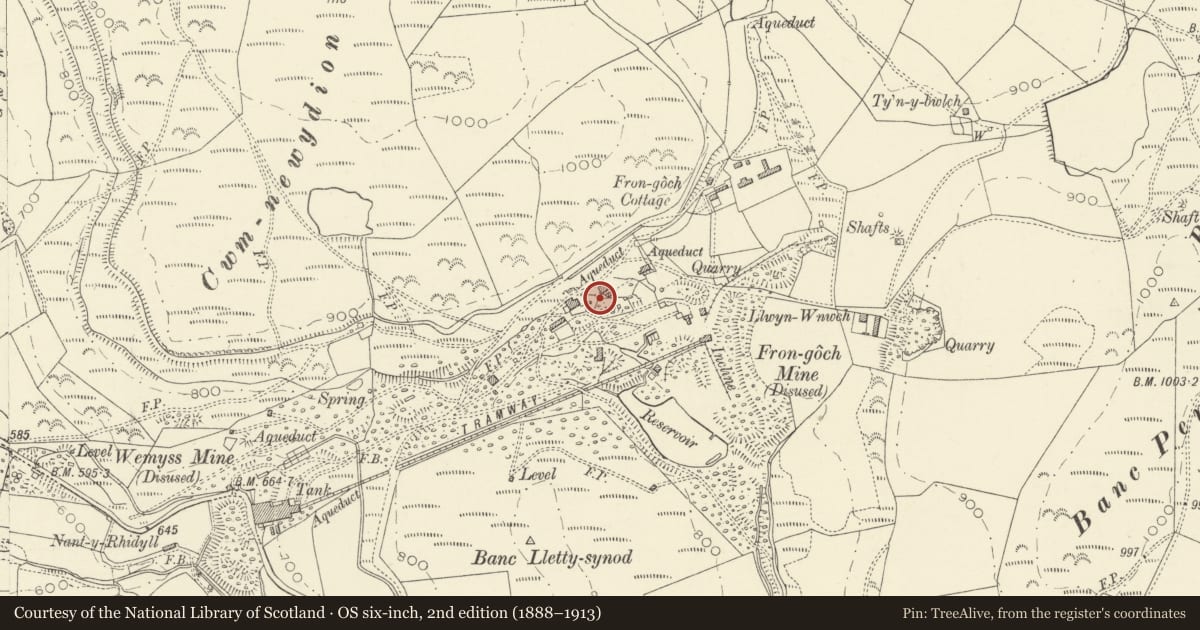
Slide toward Today to fade the historical sheet and see the modern map underneath.
David Rumsey Map Collection, Stanford LibrariesDavid Rumsey Map Collection, Stanford LibrariesDavid Rumsey Map Collection, Stanford LibrariesBayerische Staatsbibliothek, MunichDavid Rumsey Map Collection, Stanford Libraries
5 historical maps cover this location, the earliest the 1588 map "Ortelius, Abraham: Theatro De La Tierra Universal. 0" (Bayerische Staatsbibliothek, Munich).
Historical maps covering this location
- 1588 · Ortelius, Abraham: Theatro De La Tierra Universal. 0 (Bayerische Staatsbibliothek, Munich)
- 1608 · (13) Cambriae Typus. (David Rumsey Map Collection, Stanford Libraries)
- 1896 · Sheet 7. Ordnance Survey of England and Wales. (David Rumsey Map Collection, Stanford Libraries)
- 1899 · 178 Llanilar (Hills) (David Rumsey Map Collection, Stanford Libraries)
- 1901 · Sheet 14. (David Rumsey Map Collection, Stanford Libraries)
Cadw's description
Summary description and reason for designation
The following provides a general description of the Scheduled Monument.
The monument comprises the substantial remains of a lead mine including ruined stone rubble buildings, spoil heaps, its water-management and transport systems, extraction and dressing processes with their power systems. It was first leased in 1759. There was a shaft on site before John Taylor and the Lisburne Mines Co took over in 1834. He installed a steam engine for winding and crushing the ore in 1841 but the cost of carrying coal from Aberystwyth made this uneconomic and the mine reverted to a waterwheel. Two more steam engines were installed for pumping and for winding in 1863, but these were again short lived. A Belgian Company took over in 1899 and installed new electrically driven machinery, but production ceased in 1910.
The monument is of national importance for its potential to enhance and illustrate our knowledge and understanding of mining technology from a single period. Lead mines may be part of a larger cluster of industrial monuments and their importance can be further enhanced by their group value.
The scheduled area comprises the remains described and areas around them within which related evidence may be expected to survive.
Nearby in the register
- RockviewIndustrialunder 1 mi
- Telephone Call-box to SE of Capel TrisantCommunicationsunder 1 mi
- Capel TrisantReligious, Ritual and Funeraryunder 1 mi
- Ty CapelDomesticunder 1 mi
Other entries of the same register within about three miles of this one, by straight line.