Cof Cymru: National Historic Assets of Wales · Wales
Statue and pedestal, to David Davies of Llandinam
Llandinam, Powys, Wales
A Grade II* listed building in Llandinam, Powys, designated on 10 March 1953.
The record
- Designation
- Listed building, Grade II*
- Broad class
- Commemorative
- Date of designation
- 10 March 1953
- Locality
- Llandinam
- Community
- Llandinam
- Unitary authority
- Powys
- Country
- Wales
- Coordinates
- 52.48654, -3.43676
- Cadw reference
- 15654
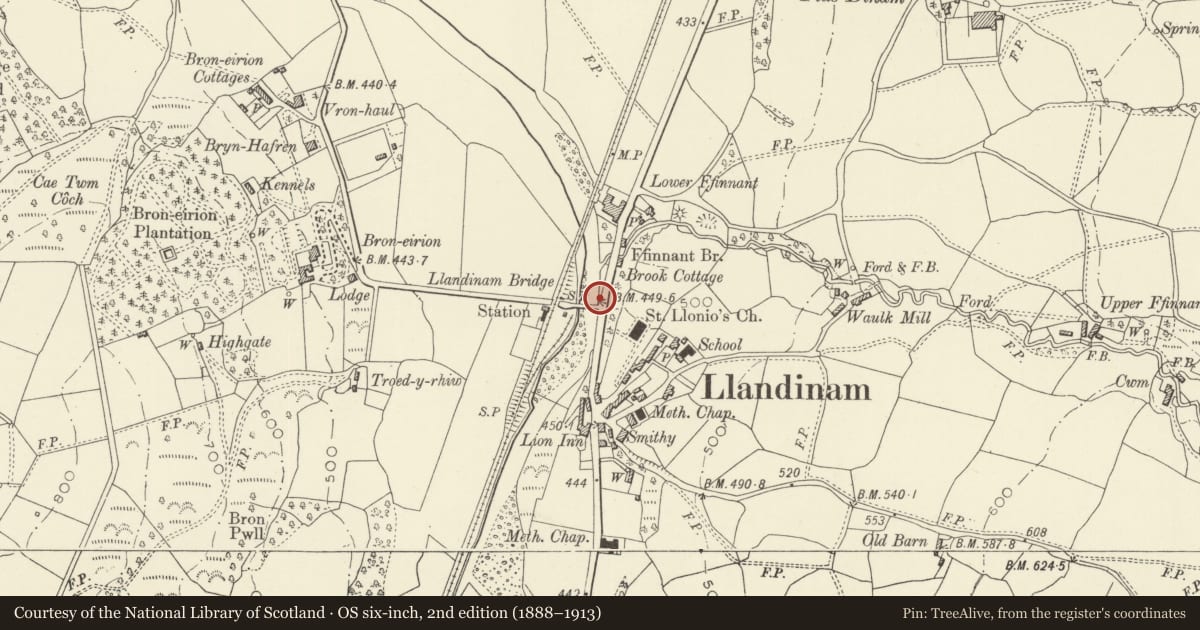
Slide toward Today to fade the historical sheet and see the modern map underneath.
David Rumsey Map Collection, Stanford LibrariesDavid Rumsey Map Collection, Stanford LibrariesDavid Rumsey Map Collection, Stanford LibrariesDavid Rumsey Map Collection, Stanford LibrariesDavid Rumsey Map Collection, Stanford Libraries
5 historical maps cover this location, the earliest the 1608 map "(13) Cambriae Typus." (David Rumsey Map Collection, Stanford Libraries).
Historical maps covering this location
- 1608 · (13) Cambriae Typus. (David Rumsey Map Collection, Stanford Libraries)
- 1637 · Particular description of Wales. Cambria seu Wallia (David Rumsey Map Collection, Stanford Libraries)
- 1883 · Watershed map England, Wales 3. (David Rumsey Map Collection, Stanford Libraries)
- 1899 · 164 Llanidloes (Hills) (David Rumsey Map Collection, Stanford Libraries)
- 1901 · Sheet 14. (David Rumsey Map Collection, Stanford Libraries)
Cadw's description
Location
Situated at the roadside, set back from the eastern end of Llandinam Bridge.
History
The statue was designed in 1890-93 by Alfred Gilbert, sculptor of London, and cast by George Broad and Sons of London, being the second of two; the first stands outside the Board Offices of Barry Dock. The Llandinam statue was erected in 1893 by the bridge that was his first important success, in the parish of his birth.
David Davies (1818-1890) was a self-made engineer, industrialist, entrepreneur and later the Liberal Member of Parliament for Cardigan. He was born in Llandinam, living first at a very modest farmhouse, Draintewion, on Allt gothi, and started work as a sawyer, but it was his commission to make the foundations and approaches to Llandinam Bridge that launched his career as a civil engineering contractor. He built some of the first railway lines in Wales; including the Llanidloes and Newtown (1859) and the Vale of Clwyd Railways. He opened coal mines in the Rhondda Valley, including the Parc and Maerdy pits, and later managed what were known as the 'Ocean Merthyr' pits. He formed a private company in 1887, which he chaired, which became the Ocean Coal Company Ltd. It was this venture, and the inability of the Bute Docks at Cardiff to handle such a large output of coal that led to his plans for a new dock at Barry (1899), together with the necessary railway connections.
Exterior
A standing bronze figure of David Davies in workaday clothes, his left foot forward, studying a plan for the dock and railway development at Barry. The figure stands on a high square plinth of limestone, with a wide cornice of granite. On one side is the inscription DAVID DAVIES 1818-1890.
Reason for designation
Included as a public statue of very high artistic quality by a major artist, and of group value with the Grade II* Llandinam Bridge.
Nearby in the register
- Llandinam BridgeTransportunder 1 mi
- Church of St LlonioReligious, Ritual and Funeraryunder 1 mi
- Malthouse CottageDomesticunder 1 mi
- Llandinam InstituteRecreationalunder 1 mi
Other entries of the same register within about three miles of this one, by straight line.