Cof Cymru: National Historic Assets of Wales · Wales
Remains of Tondu Ironworks
Ynysawdre, Bridgend, Wales
A scheduled monument in Ynysawdre, Bridgend, recorded as Ironworks (Post Medieval/Modern).
The record
- Designation
- Scheduled monument
- Site type
- Ironworks
- Period
- Post Medieval/Modern
- Date of designation
- 7 November 1985
- Community
- Ynysawdre
- Unitary authority
- Bridgend
- Country
- Wales
- Coordinates (centre of the scheduled area)
- 51.54793, -3.59989
- SAM number
- GM433
- Cadw record number
- 2911
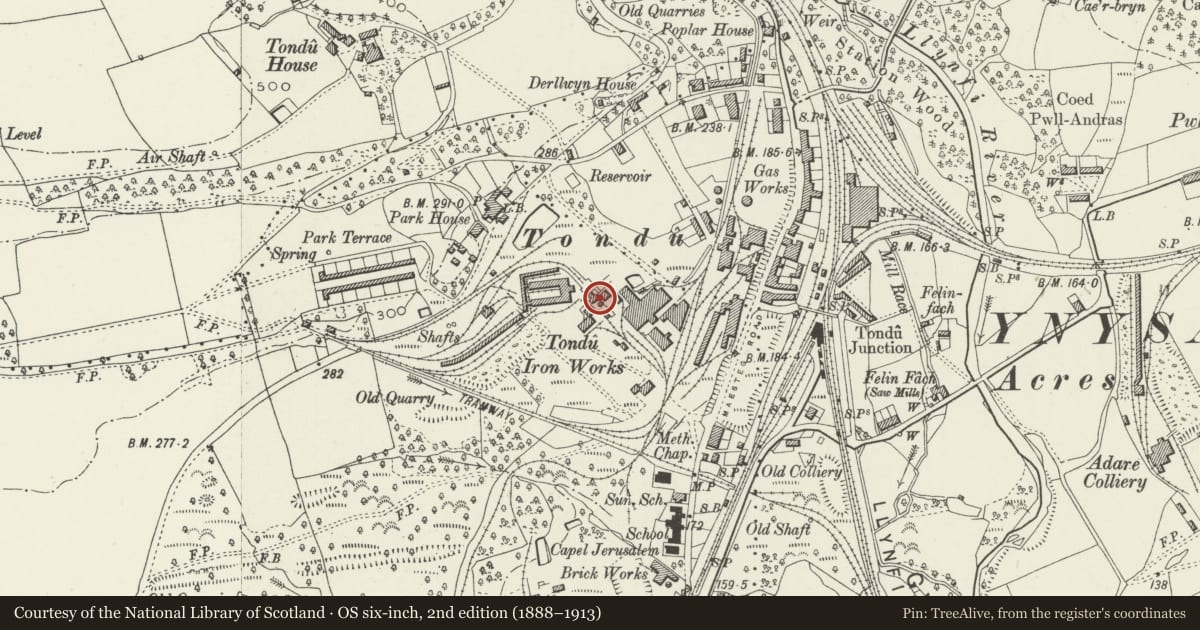
Slide toward Today to fade the historical sheet and see the modern map underneath.
David Rumsey Map Collection, Stanford LibrariesUniversity Library, Vrije Universiteit AmsterdamDavid Rumsey Map Collection, Stanford LibrariesUniversity Library, Vrije Universiteit AmsterdamDavid Rumsey Map Collection, Stanford Libraries
5 historical maps cover this location, the earliest the 1608 map "(13) Cambriae Typus." (David Rumsey Map Collection, Stanford Libraries).
Historical maps covering this location
- 1608 · (13) Cambriae Typus. (David Rumsey Map Collection, Stanford Libraries)
- 1636 · Cornubia : Devonia, Somersetus, Dorcestria, Wiltonia, Glocestria ... (David Rumsey Map Collection, Stanford Libraries)
- 1907 · 248 Pontypridd (Hills) (David Rumsey Map Collection, Stanford Libraries)
- Sheet 7 South Wales (University Library, Vrije Universiteit Amsterdam)
- [Kaart] (University Library, Vrije Universiteit Amsterdam)
Cadw's description
Summary description and reason for designation
The following provides a general description of the Scheduled Ancient Monument.
The monument comprises the remains of several buildings, including a blast furnace, coke oven and leat, and an open excavated area related to the production of iron. Tondu Ironworks was initially a complex of rolling mills, prior to 1853. The works were expanded sometime between 1854 and 1875 to include 23 puddling furnaces and brick stacks, 10 balling furnaces, 4 rolling mill engines and 4 sets of rolling mills, with an associated boiler house of 8 Lancashire boilers and 2 chimneys.
The monument is of national importance for its potential to enhance and illustrate our knowledge and understanding of the development of the iron industry. An ironworks may be part of a larger industrial complex and their importance can further enhanced by their group value.
The scheduled area comprises the remains described and areas around them within which related evidence may be expected to survive.
Nearby in the register
- Former Blast Engine Houses at Tondu IronworksIndustrialunder 1 mi
- Lift Tower at Tondu IronworksIndustrialunder 1 mi
- Calcining Kilns and attached abutment at Tondu IronworksIndustrialunder 1 mi
- Former Truck Shop Tondu Ironworks now Foxtroy Residential HomeCommercialunder 1 mi
Other entries of the same register within about three miles of this one, by straight line.