Cof Cymru: National Historic Assets of Wales · Wales
Maesteg blast furnaces
Maesteg, Bridgend, Wales
A scheduled monument in Maesteg, Bridgend, recorded as Blast Furnace (Post Medieval/Modern).
The record
- Designation
- Scheduled monument
- Site type
- Blast Furnace
- Period
- Post Medieval/Modern
- Date of designation
- 28 August 1980
- Community
- Maesteg
- Unitary authority
- Bridgend
- Country
- Wales
- Coordinates (centre of the scheduled area)
- 51.61136, -3.66428
- SAM number
- GM418
- Cadw record number
- 390
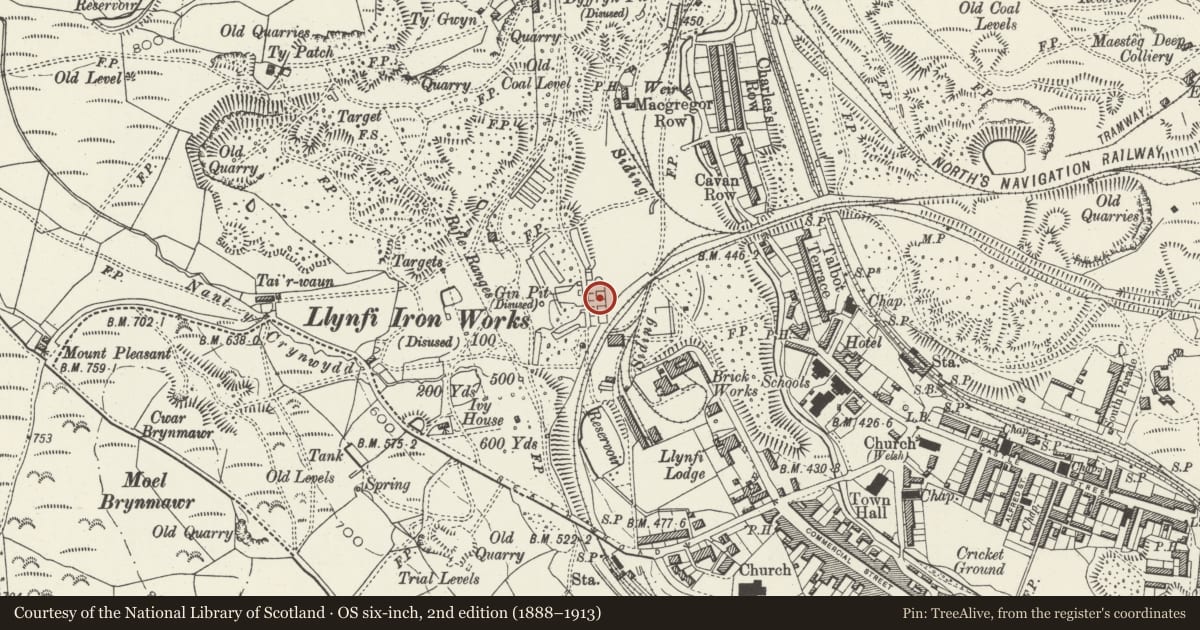
Slide toward Today to fade the historical sheet and see the modern map underneath.
David Rumsey Map Collection, Stanford LibrariesDavid Rumsey Map Collection, Stanford LibrariesUniversity Library, Vrije Universiteit AmsterdamUniversity Library, Vrije Universiteit AmsterdamBayerische Staatsbibliothek, Munich
5 historical maps cover this location, the earliest the 1588 map "Ortelius, Abraham: Theatro De La Tierra Universal. 0" (Bayerische Staatsbibliothek, Munich).
Historical maps covering this location
- 1588 · Ortelius, Abraham: Theatro De La Tierra Universal. 0 (Bayerische Staatsbibliothek, Munich)
- 1608 · (13) Cambriae Typus. (David Rumsey Map Collection, Stanford Libraries)
- 1907 · 248 Pontypridd (Hills) (David Rumsey Map Collection, Stanford Libraries)
- Sheet 7 South Wales (University Library, Vrije Universiteit Amsterdam)
- [Kaart] (University Library, Vrije Universiteit Amsterdam)
Cadw's description
Summary description and reason for designation
The following provides a general description of the Scheduled Ancient Monument.
The monument consists of the remains of the Maesteg blast furnaces dating to the 19th century. The original blast furnace was built here in 1837 by the Cambrian Iron and Spelter Company. The blowing engine house was added later in 1839-40. Further furnaces were added in 1841, 1846 and 1850. The ironworks ceased production in 1886.
The monument is of national importance for its potential to enhance and illustrate our knowledge and understanding of the development of the iron industry in Wales. It retains significant archaeological potential, with the strong possibility of the presence of associated archaeological features and deposits. A blast furnace may be part of a larger cluster of industrial monuments and their importance can further enhanced by their group value.
The scheduled area comprises the remains described and areas around them within which related evidence may be expected to survive.
Nearby in the register
- Blast Furnace at Maesteg Sports CentreIndustrialunder 1 mi
- Maesteg Sports Centre, The CornstoresIndustrialunder 1 mi
- Iron bridge over River LlynfiTransportunder 1 mi
- Zoar ChapelReligious, Ritual and Funeraryunder 1 mi
Other entries of the same register within about three miles of this one, by straight line.