Cof Cymru: National Historic Assets of Wales · Wales
The 'Lock-Up', Hawarden
Hawarden, Flintshire, Wales
A scheduled monument in Hawarden, Flintshire, recorded as Lock Up (Post Medieval/Modern).
The record
- Designation
- Scheduled monument
- Site type
- Lock Up
- Period
- Post Medieval/Modern
- Community
- Hawarden
- Unitary authority
- Flintshire
- Country
- Wales
- Coordinates (centre of the scheduled area)
- 53.18417, -3.02284
- SAM number
- FL078
- Cadw record number
- 2202
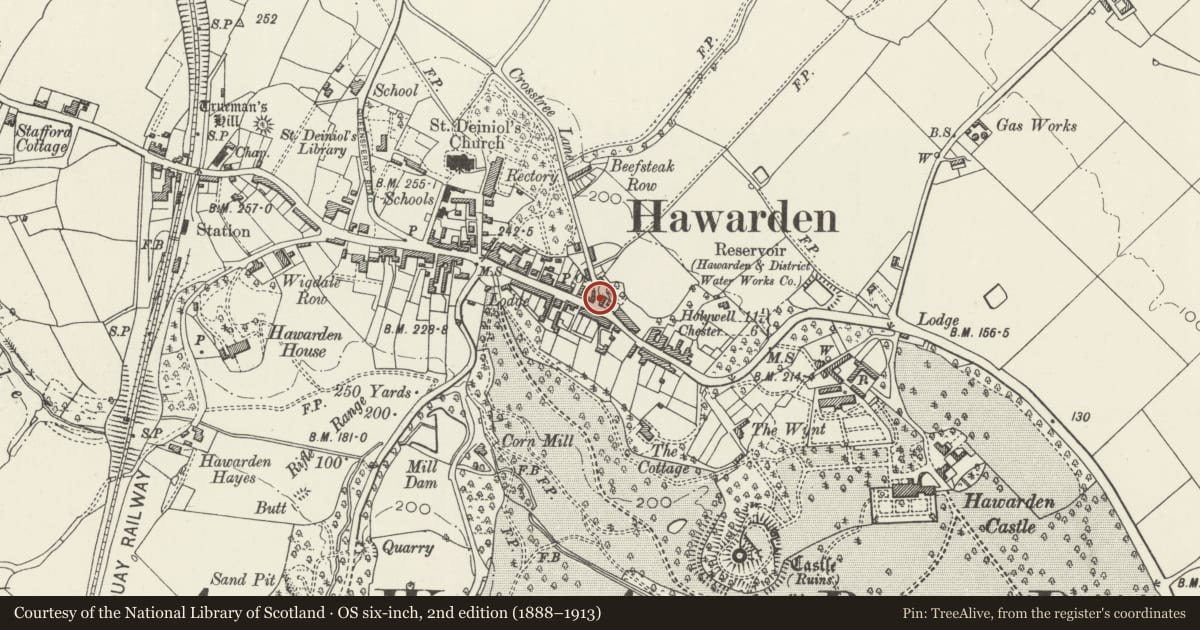
Slide toward Today to fade the historical sheet and see the modern map underneath.
David Rumsey Map Collection, Stanford LibrariesDavid Rumsey Map Collection, Stanford LibrariesDavid Rumsey Map Collection, Stanford LibrariesDavid Rumsey Map Collection, Stanford LibrariesBayerische Staatsbibliothek, Munich
5 historical maps cover this location, the earliest the 1588 map "Ortelius, Abraham: Theatro De La Tierra Universal. 0" (Bayerische Staatsbibliothek, Munich).
Historical maps covering this location
- 1588 · Ortelius, Abraham: Theatro De La Tierra Universal. 0 (Bayerische Staatsbibliothek, Munich)
- 1608 · (13) Cambriae Typus. (David Rumsey Map Collection, Stanford Libraries)
- 1898 · 108 Flint (Hills) (David Rumsey Map Collection, Stanford Libraries)
- 1898 · 108 Flint (Outline) (David Rumsey Map Collection, Stanford Libraries)
- 1901 · Sheet 9 and 10. (David Rumsey Map Collection, Stanford Libraries)
Cadw's description
Summary description and reason for designation
The following provides a general description for the scheduled ancient monument.
The monument consists of a lock-up, a prison used for temporary detention. The typical village lock-up was a one-storeyed, one-celled building, sometimes of round or polygonal plan. The 'Lock-Up' in Hawarden consists of a square of dressed sandstone 3.45m square, with two storeys and a basement entrance. It dates to the 18th century. Consolidation and restoration work was carried out in the 1990's. The sandstone exterior of the building was cleared of oxides and mould to reveal pale yellow, golden and light red sandstone in the construction. The lintels surrounding the former window opening is blocked by 2 pieces of well consolidated masonry. The north side of the Lock Up has also been cleaned. The timber doorway in the south face of the building has been restored, the door is covered by iron studs and supported by 2 hinges and 2 horizontal bars. The 3 stone steps leading up to the doorway have been consolidated. The broken column and damaged capital on the left of the doorway have been restored with a new piece of sandstone incorporated into the column. The 2 capitals support a stone entablature and a cornice top. The entablature is incised 'House of Correction'
The monument is of national importance for its potential to enhance our knowledge of judicial systems. It retains significant archaeological potential, with a strong probability of the presence of associated archaeological features and deposits. The structure itself may be expected to contain archaeological information concerning chronology and building techniques.
The scheduled area comprises the remains described and areas around them within which related evidence may be expected to survive.
Nearby in the register
- The Correction HouseCivilunder 1 mi
- Base of Former Village PumpGardens, Parks and Urban Spacesunder 1 mi
- 50Domesticunder 1 mi
- 52 Glynne WayDomesticunder 1 mi
Other entries of the same register within about three miles of this one, by straight line.