Cof Cymru: National Historic Assets of Wales · Wales
Hafod Camp
Llanboidy, Carmarthenshire, Wales
A scheduled monument in Llanboidy, Carmarthenshire, recorded as Promontory Fort - inland (Prehistoric).
The record
- Designation
- Scheduled monument
- Site type
- Promontory Fort - inland
- Period
- Prehistoric
- Date of designation
- 19 February 1953
- Community
- Llanboidy
- Unitary authority
- Carmarthenshire
- Country
- Wales
- Coordinates (centre of the scheduled area)
- 51.87287, -4.59015
- SAM number
- CM166
- Cadw record number
- 3442
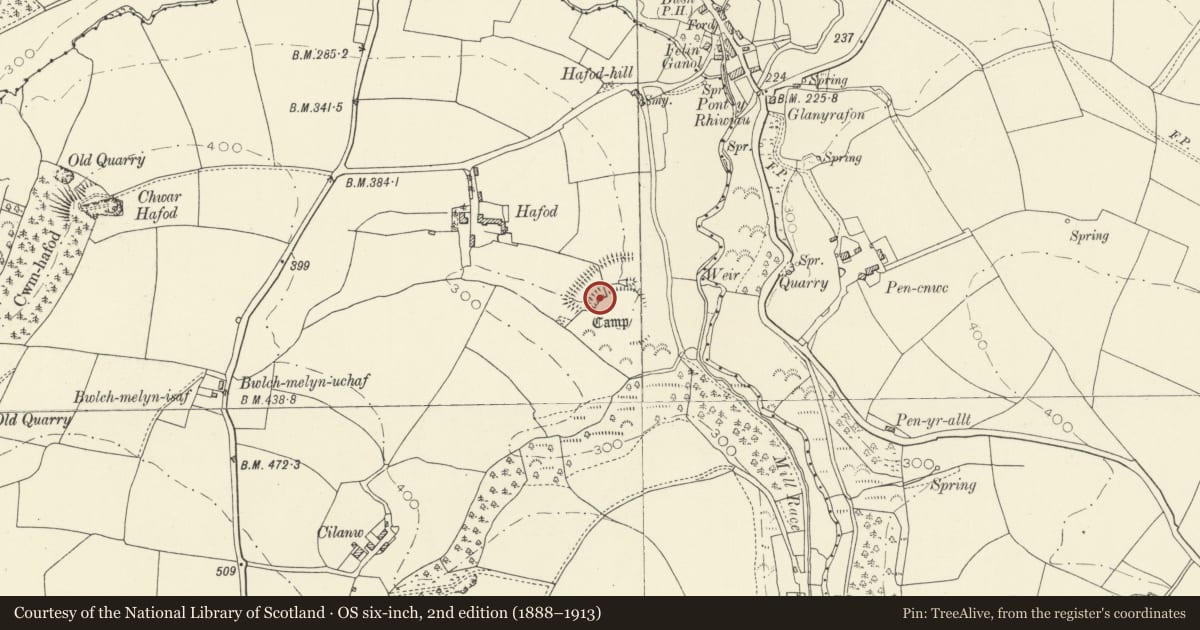
Slide toward Today to fade the historical sheet and see the modern map underneath.
David Rumsey Map Collection, Stanford LibrariesDavid Rumsey Map Collection, Stanford LibrariesDavid Rumsey Map Collection, Stanford LibrariesDavid Rumsey Map Collection, Stanford LibrariesDavid Rumsey Map Collection, Stanford Libraries
5 historical maps cover this location, the earliest the 1608 map "(13) Cambriae Typus." (David Rumsey Map Collection, Stanford Libraries).
Historical maps covering this location
- 1608 · (13) Cambriae Typus. (David Rumsey Map Collection, Stanford Libraries)
- 1636 · Cornubia : Devonia, Somersetus, Dorcestria, Wiltonia, Glocestria ... (David Rumsey Map Collection, Stanford Libraries)
- 1637 · Particular description of Wales. Cambria seu Wallia (David Rumsey Map Collection, Stanford Libraries)
- 1830 · V.3:11-15:XV. Britisches Reich. A. Kon: England. b. Frstenthum Wales: Shire: 37-40 (David Rumsey Map Collection, Stanford Libraries)
- 1891 · Sheet 10. Ordnance Survey of England and Wales. . (David Rumsey Map Collection, Stanford Libraries)
Cadw's description
Summary description and reason for designation
The following provides a general description of the Scheduled Ancient Monument.
The monument comprises the remains of a defended enclosure, which probably dates to the Iron Age period (c. 800 BC - AD 74, the Roman conquest of Wales). Inland promontory forts are usually located on a ridge or spur with steep slopes on 2 or 3 sides, and artificial ramparts on the level approaches. Alternatively they may have been constructed on a promontory above the confluence of two rivers, or in the bend of a meander. Hafod Camp is defended by a double bank and ditch, covered with trees on the main bank and grass elsewhere.
The monument is of national importance for its potential to enhance our knowledge of later prehistoric defensive organisation and settlement. The site forms an important element within the wider later prehistoric context and within the surrounding landscape. The site is well preserved and retains considerable archaeological potential. There is a strong probability of the presence of evidence relating to chronology, building techniques and functional detail.
The scheduled area comprises the remains described and areas around them within which related evidence may be expected to survive.
Nearby in the register
- Llanboidy Mound & Bailey CastleMotte and Baileyunder 1 mi
- The Market HallCivilunder 1 mi
- The Maesgwynne Arms HotelDomesticunder 1 mi
- Trinity Independent ChapelReligious, Ritual and Funeraryunder 1 mi
Other entries of the same register within about three miles of this one, by straight line.