Cof Cymru: National Historic Assets of Wales · Wales
Statue of Hercules and pedestal at Gloddaeth Hall
Llandudno, Conwy, Wales
A Grade II* listed building in Gloddaeth Hall, Llandudno, Conwy, designated on 16 March 1976.
The record
- Designation
- Listed building, Grade II*
- Broad class
- Gardens, Parks and Urban Spaces
- Date of designation
- 16 March 1976
- Locality
- Gloddaeth Hall
- Community
- Llandudno
- Unitary authority
- Conwy
- Country
- Wales
- Coordinates
- 53.30915, -3.79840
- Cadw reference
- 5775
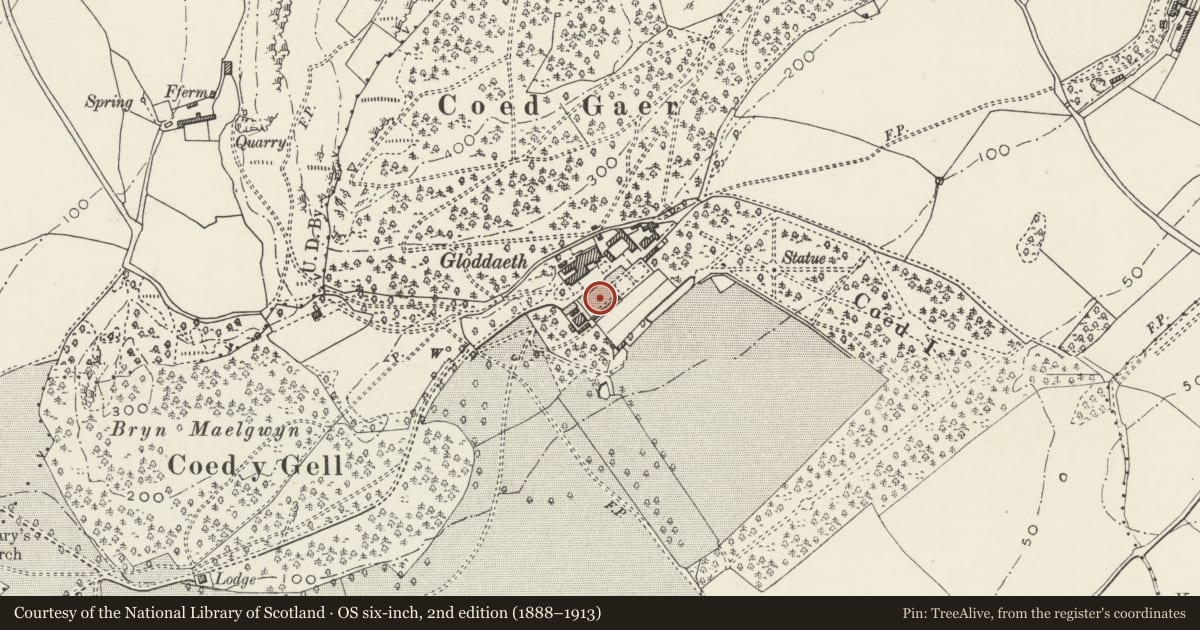
Slide toward Today to fade the historical sheet and see the modern map underneath.
David Rumsey Map Collection, Stanford LibrariesDavid Rumsey Map Collection, Stanford LibrariesDavid Rumsey Map Collection, Stanford LibrariesLlyfrgell Genedlaethol Cymru – The National Library of WalesNational Library of Scotland
5 historical maps cover this location, the earliest the 1795 map "To Sir Watkin Williams-Wynn Bart ... the map of the six counties of North Wales is most humbly inscribed by his obedient humble servant" (Llyfrgell Genedlaethol Cymru – The National Library of Wales).
Historical maps covering this location
- 1795 · To Sir Watkin Williams-Wynn Bart ... the map of the six counties of North Wales is most… (Llyfrgell Genedlaethol Cymru – The National Library of Wales)
- 1883 · Watershed map England, Wales 3. (David Rumsey Map Collection, Stanford Libraries)
- 1899 · 94 Beaumaris (Hills) (David Rumsey Map Collection, Stanford Libraries)
- 1901 · Sheet 9 and 10. (David Rumsey Map Collection, Stanford Libraries)
- 1930 · OS Popular Edition 1919-1947 (National Library of Scotland)
Cadw's description
Location
Sited in garden about 50m SE of front of Hall.
History
C18; formerly sited at the intersection of three straight walks in the wood to South-east of the hall, and moved to its present site in 1990s following restoration. Described in "A trip to Conway and Five Days in North Wales" (1837) as "somewhat mutilated. It is to be regretted that so many conceited individuals have taken the trouble to cut their initials in different parts of this figure" the initials remain. The statue is based upon the much-copied Farnese Hercules, an ancient sculpture believed to be by Glycon, discovered in 1540, and now in the Museo Nazionale Archeologico at Naples. Hercules rests after his labours, with his attributes, a club (seen as a symbol of virtue), and the skin of the Nemean lion which he strangled as the first of his twelve labours.
Exterior
Leaden cast of the Farnese Hercules on pedestal. Muscular naked male figure with beard, leaning on club draped with lion skin to his R. On stone ashlar pedestal.
Reason for designation
Graded II* as rare example of C18 garden statuary.
Nearby in the register
- Terrace Wall bounding S Side of Main Forecourt at Gloddaeth HallDomesticunder 1 mi
- Wall on W Side of Garden in front of Gloddaeth HallDomesticunder 1 mi
- Bothy Cottage at Gloddaeth HallDomesticunder 1 mi
- Terrace Wall and Guns enclosing S side of Garden in front of Gloddaeth HallDomesticunder 1 mi
Other entries of the same register within about three miles of this one, by straight line.