Cof Cymru: National Historic Assets of Wales · Wales
Former Plas power Colliery Workshops
Broughton, Wrexham, Wales
A Grade II listed building in Southsea, Broughton, Wrexham, designated on 26 September 1994.
The record
- Designation
- Listed building, Grade II
- Broad class
- Commercial
- Date of designation
- 26 September 1994
- Locality
- Southsea
- Community
- Broughton
- Unitary authority
- Wrexham
- Country
- Wales
- Coordinates
- 53.06003, -3.04726
- Cadw reference
- 15820
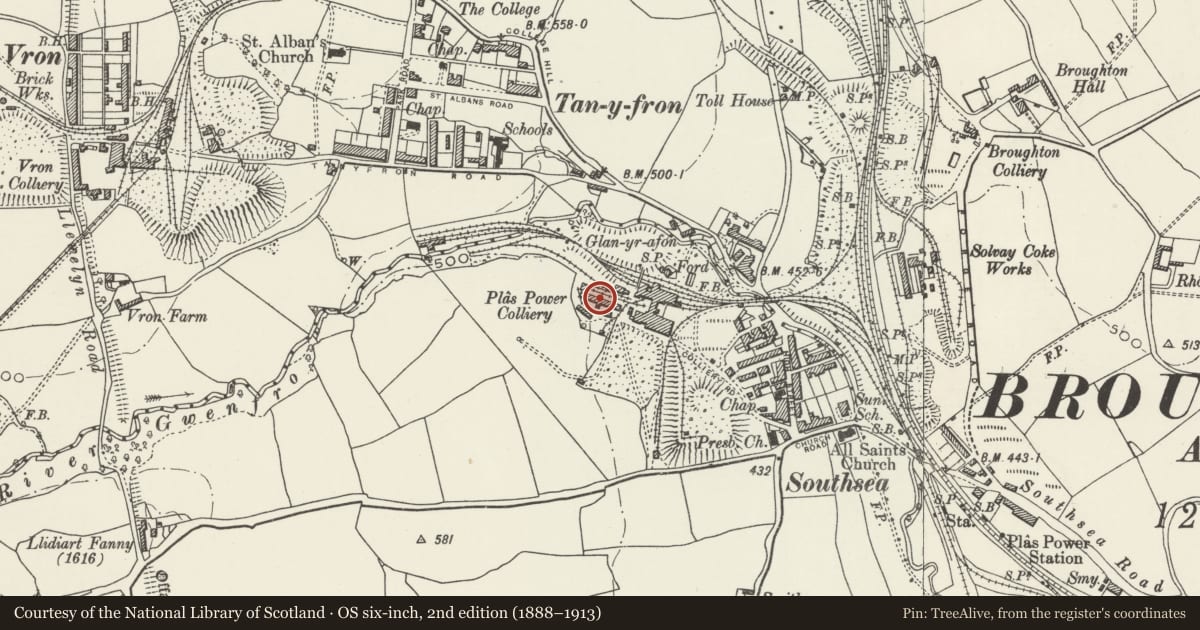
Slide toward Today to fade the historical sheet and see the modern map underneath.
David Rumsey Map Collection, Stanford LibrariesDavid Rumsey Map Collection, Stanford LibrariesDavid Rumsey Map Collection, Stanford LibrariesLlyfrgell Genedlaethol Cymru – The National Library of WalesDavid Rumsey Map Collection, Stanford Libraries
5 historical maps cover this location, the earliest the 1608 map "(13) Cambriae Typus." (David Rumsey Map Collection, Stanford Libraries).
Historical maps covering this location
- 1608 · (13) Cambriae Typus. (David Rumsey Map Collection, Stanford Libraries)
- 1795 · To Sir Watkin Williams-Wynn Bart ... the map of the six counties of North Wales is most… (Llyfrgell Genedlaethol Cymru – The National Library of Wales)
- 1883 · Watershed map England, Wales 3. (David Rumsey Map Collection, Stanford Libraries)
- 1898 · 121 Wrexham (Hills) (David Rumsey Map Collection, Stanford Libraries)
- 1901 · Sheet 9 and 10. (David Rumsey Map Collection, Stanford Libraries)
Cadw's description
Location
Located at the centre of the group of former Plas Power Colliery buildings now known as Southsea Industrial Estate.
History
Plas Power Colliery was established in 1875 by the Old Broughton Coal Company (later the Broughton and Plas Power Coal Company). Its directors in 1881 included three of the most important industrialists in Wales, Henry Robertson, W.H.Darby and C.E.Darby, who were also the owners of Brymbo Steelworks. The colliery was one of the largest and most modern in North Wales at the turn of the century, and at its peak employed 1,100 men, The steam coal produced was used in railways and shipping, notably supplying companies such as Cunard, P&O, the Great Western Railway, and the Great Indian Peninsular Railway. The colliery closed in 1938. The workshops range appears to date from the original establishment of the colliery.
Exterior
The workshops form an exceptionally long and thin single-storey building, roughly 55m by 10m. It is constructed of roughly coursed sandstone with a corrugated gabled roof. Tall windows on the long elevations are irregularly spaced, but represent roughly 22 bays. Most have round-headed arches, but some have straight stone lintels. There are three square-headed openings to the SE gable. Most windows are blocked or have replacement glazing. Two red-brick chimneys are positioned at the apex of the roof in the E half of the block.
Interior
The building is divided into separate workshops along its length with stone walls and later partitions. There is a king-post timber roof.
Reason for designation
Listed as an impressive colliery workshop, one of very few surviving in North Wales, and for group value with other buildings of Plas Power Colliery.
Nearby in the register
- Former Plas Power Colliery Power HouseIndustrialunder 1 mi
- Former Plas Power Colliery Western Winding Engine HouseIndustrialunder 1 mi
- Former Plas power Colliery Eastern winding Engine HouseIndustrialunder 1 mi
- Former Plas Power Colliery HeapsteadIndustrialunder 1 mi
Other entries of the same register within about three miles of this one, by straight line.