Sites and Monuments Record · Ireland
Tomb - effigial
Killeen, County Meath, Ireland
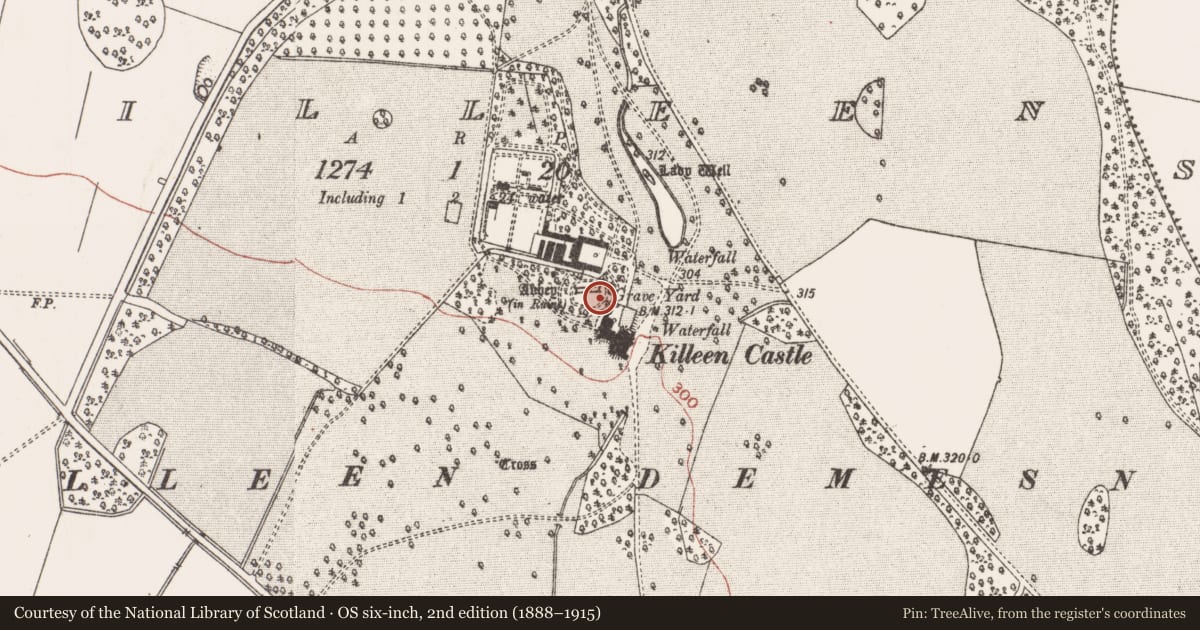
The record
- Townland
- Killeen
- County
- Meath
- Country
- Ireland
- First-edition OS map
- Not indicated
- Latest-edition OS map
- Not indicated
- Coordinates
- 53.53607, -6.59448
- SMR number
- ME038-013003-
Slide toward Today to fade the historical sheet and see the modern map underneath.
David Rumsey Map Collection, Stanford LibrariesDavid Rumsey Map Collection, Stanford LibrariesDavid Rumsey Map Collection, Stanford LibrariesDavid Rumsey Map Collection, Stanford Libraries
4 historical maps cover this location, the earliest the 1790 map "Composite: Ireland." (David Rumsey Map Collection, Stanford Libraries).
Historical maps covering this location
- 1790 · Composite: Ireland. (David Rumsey Map Collection, Stanford Libraries)
- 1799 · Ireland. (David Rumsey Map Collection, Stanford Libraries)
- 1830 · V.3:11-15:XV. Britisches Reich. C. Kon: Ireland. a. Prov: Leinster. Counties: 1-12 (David Rumsey Map Collection, Stanford Libraries)
- 1891 · Ireland 16 (David Rumsey Map Collection, Stanford Libraries)
This record in the National Monuments Service's Historic Environment Viewer ↗
The National Monuments Service's description
This is a large stone in the NE angle of the chancel that has fractured and is now largely made up with cement (dims 2.33m x 1.25m; H 5-6cm). The shallow imprint of a bishop (H 1.23m; Wth of torso 0.27m; Wth at base 0.57m) can be seen at the centre of the stone with the head at the E. (FitzGerald 1911, 405-06, No. III; Moore 1970, 24, No. 1; Hunt 1974, 210, No. 195)
It is described by FitzGerald as: This is a large slab, unsculptured, except for a sunken portion in the middle, showing by its outline that it contained the brass of a bishop of small size. The bishop wore a mitre, and held a crozier, the head of which, turning outwards, appears on his left side. Brasses in Ireland are of very rare occurrence.
If a guess might be hazarded, the tomb may possibly belong to Dr. William Silke, who, according to Ware’s “Bishops of Ireland,” was Bishop of Meath from 1434 to 1450, in which latter year he died at Ardbraccan on the 9th of May, and ‘lies buried in the church of St. Mary at Killeen.”
Date of upload: 18 March, 2015
References
Moore, B.F.E. 1970 Tombs in St Mary's ruined church, Killeen. Ríocht na Mídhe, 4, 4, 24-9.
FitzGerald, Lord W. 1911 Killeen Church Ruins. Journal of the Association for the Preservation of the Memorials of the Dead in Ireland, 8, 2, 401-.18
Hunt, J. 1974 Irish medieval figure sculpture 1200-1600, 2 vols. Dublin. Irish University Press.
Nearby in the register
- Tomb - effigialunder 1 mi
- Wall monumentunder 1 mi
- Tomb - effigialunder 1 mi
- Tomb - effigialunder 1 mi
Other entries of the same register within about three miles of this one, by straight line.